Many organizers assume anyone with a confident voice can handle the mic. In practice, results vary enormously depending on preparation, energy management, and audience connection. A recognized emcee framework from Toastmasters International treats the role as crucial to the success of company, professional-association, and nonprofit events — not just a nice-to-have.
This guide walks through the exact steps to prepare and host an event, the skills that separate great emcees from average ones, common mistakes to avoid, and how to decide between hosting it yourself or bringing in a professional.
Key Takeaways
- Emceeing is a preparation-driven skill: scripting and rehearsal matter more than charisma
- The emcee's job is to spotlight speakers, sponsors, and the audience, never themselves
- Reading the room and staying composed through mistakes are the core live skills
- Most failures trace back to under-preparation or ego, not lack of talent
- DIY vs. hiring a pro depends on event size, stakes, and internal bandwidth
How to Emcee an Event: Step-by-Step
Great emceeing looks effortless on stage because the real work happens before anyone walks up to the podium. Here's the process, broken into four stages.
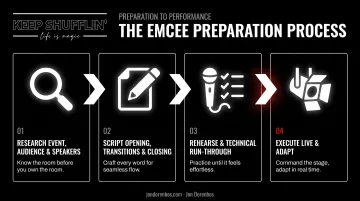
Step 1: Research the Event, Audience, and Speakers
Start with the event itself. Study its purpose, past programs, and audience demographics before you write a single word of your script. A tone that worked for last year's sales kickoff might completely miss the mark at a nonprofit gala.
Then go straight to the source: talk to each speaker directly. PCMA's speaker-preparation guidance recommends interactive planning calls and a designated point of contact well before the event, ideally four to six weeks out for larger conferences.
Don't rely on a written bio alone. Confirm:
- Correct name pronunciation (write it out phonetically if needed)
- Their key talking points and desired audience takeaway
- Any last-minute changes to their topic or credentials
Step 2: Script Your Opening, Transitions, and Closing
Your opening carries more weight than anything else you'll say. Draft and memorize it so delivery feels natural, not read off a card. It should welcome the audience, set expectations, and cover basic logistics (restrooms, wifi, schedule) without sounding like a flight attendant's safety briefing.
For each speaker, prepare a short, specific introduction: three to four sentences covering their topic, their authority on it, and their name and title. Skip the full resume. Save the details that matter to this audience.
Close with a script too. Thank stakeholders by name, and leave the audience with something to carry out the door, not just "thanks for coming."
Step 3: Rehearse and Complete a Technical Run-Through
Arrive early enough to walk the stage, test the mic, and run transitions with the AV team. Treat this as a required release gate, not optional polish.
One Toastmasters example shows why: stage lighting in rehearsal was bright enough to blind speakers from seeing the audience. The problem only surfaced because someone tested it beforehand.
Prepare a few simple filler moves for delays or technical hiccups:
- A quick audience question or show-of-hands moment
- A short, relevant story you can stretch or shrink
- A brief interactive bit with someone in the front row
Step 4: Execute Live and Adapt in Real Time
Match the room's existing energy before you try to build it. Walking into a quiet, formal crowd with maximum volume and jokes rarely lands. Read the temperature first, then raise it gradually.
Facial expressions alone are a poor gauge of how people feel. Toastmasters' audience-analysis research notes that a furrowed brow might just mean concentration, and avoiding eye contact isn't always disengagement. Watch for clearer signals instead: applause energy, laughter timing, and how quickly people settle after a break.
When you make a mistake, name it briefly, fix it if needed, and move on. Dwelling on it does more damage than the mistake itself.
Essential Skills and Preparation Every Emcee Needs
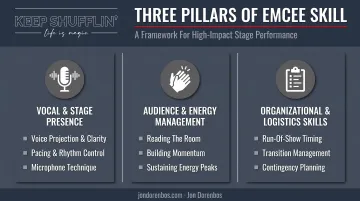
Stage presence alone isn't enough. The strongest emcees combine vocal control, emotional intelligence, and behind-the-scenes organization. None of those three substitutes for the others.
Vocal and Stage Presence
Clear projection and deliberate pacing keep an audience engaged without straining to follow you. This includes breath control, posture, and varying your tempo so you're not delivering every sentence at the same speed.
Microphone technique matters more than people expect. Confirm your mic type (handheld, lapel, or headset) during your speaker-prep calls, then test it onsite before doors open.
Audience and Energy Management
Reading a room is part instinct, part discipline. Watch for:
- Laughter timing and intensity
- How quickly a crowd resettles after breaks
- Whether questions come easily or need coaxing
Humor should include people, not target them. A joke that makes fun of a specific attendee or company rarely ages well by the reception.
Organizational and Logistics Skills
The audience never sees this part, and that's intentional. Skill at managing timing, cues, and coordination with planners, speakers, and AV staff keeps a program from visibly falling apart.
Build these habits into every event:
- Keep a minute-by-minute schedule
- Know where every speaker is before their cue
- Never leave the stage empty during a transition
Common Mistakes to Avoid When Emceeing
Most emcee failures come from preventable, repeatable errors that show up the same way at nearly every event.
- Making it about yourself. Over-talking, self-promoting, or competing with speakers for laughs pulls focus from the people the audience actually came to hear.
- Skipping preparation. Improvising the opening or guessing at speaker names instead of confirming them beforehand is the single most avoidable mistake on this list.
- Mismatched energy. Starting too high for a reflective, low-key crowd, or too flat for a room that's already buzzing, breaks trust with the audience fast.
- Ignoring the backstage environment. Focusing only on your stage performance while planners and speakers handle stress behind the curtain creates problems that eventually surface in front of the audience.
A production checklist from Cvent lists dozens of things that commonly go sideways at live events: delayed speakers, last-minute AV changes, presentations that weren't shared in advance. None of these are rare. That is why preparation sits at the center of the job.
When to Hire a Professional Emcee vs. Hosting It Yourself
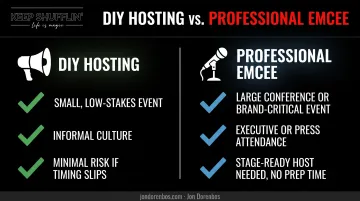
The right choice depends on event size, stakes, and how much bandwidth your internal team actually has — not just budget.
DIY hosting works well when:
- The event is small and low-stakes, like a team meeting or internal town hall
- The culture is informal and the audience already knows the presenter
- There's minimal risk if timing runs a little loose or the energy dips
A professional makes more sense when:
- The event is a large conference, product launch, or brand-critical gathering
- Executive stakeholders, clients, or press will be in the room
- Your team needs someone who can command a stage cold, without months of internal build-up
For events that want both a polished host and a memorable keynote moment, a speaker like Jon Dorenbos covers both roles in one appearance. A 14-year NFL veteran turned magician and America's Got Talent finalist, Dorenbos has delivered more than 1,000 live appearances for organizations including Marriott, Kroger, RE/MAX, Campbell Soup Company, and Apple.
RE/MAX President and CEO Nick Bailey called him "the BEST KEYNOTE SPEAKER I have ever seen," noting he received an unsolicited standing ovation halfway through his talk.
Customization is what separates this from a standard hired host. Dorenbos builds his presentation (magic, personal narrative, and message) around each client's specific theme. He's used a live illusion to visually illustrate a client's conference slogan mid-presentation.
For a leadership offsite, sales kickoff, or national association event, that level of tailoring is a different category of investment than booking a local host.
Conclusion
Successful emceeing comes down to three things: thorough preparation, adaptable energy, and a genuine focus on spotlighting others instead of yourself. Most emcees who struggle skip the research, the script, or the run-through—not because they lack talent.
Whether you handle it internally or bring in a professional, the right host sets the tone for an event people remember, not one they merely sat through.
Frequently Asked Questions
Is emceeing a skill?
Yes. Emceeing is a learnable mix of preparation habits, audience awareness, and improvisation. Anyone can build it with practice.
What does emceeing mean?
Emceeing means acting as master of ceremonies: hosting a program, introducing speakers or performers, and keeping the event flowing smoothly from start to finish.
Is it MCing or emceeing?
Both spellings refer to the same role. "Emcee" is the more common written form outside hip-hop contexts, while "MC" traces back to the same abbreviation.
What is another word for an emcee?
Common alternatives include master of ceremonies, host, and announcer. "Presenter" and "compère" also show up in everyday usage, especially in broadcast and event settings.
How do I become a good emcee for events?
Build the habit of thorough preparation, take small hosting opportunities when they come up, and study how experienced emcees manage transitions and room energy.
Should I hire a professional emcee or host the event myself?
It depends on event size and stakes. Low-key internal events can be self-hosted comfortably, while high-visibility events benefit from an experienced professional host.