
Here's the uncomfortable part: most leaders were never taught how to communicate well. They picked it up on the job, through trial, error, and the occasional cringe-worthy feedback session. Nobody handed them a manual.
This guide breaks down what leadership communication actually means, the five skills that separate great communicators from mediocre ones, and how organizations build these capabilities across their teams, not just at the top.
Key Takeaways
- Leadership communication directly correlates with trust, engagement, and business performance
- Five core skills drive leadership communication: listening, clarity, empathy, adaptability, and transparency
- Storytelling helps leaders make abstract lessons memorable and emotionally resonant
- These skills are learnable through feedback, coaching, and modeling, not fixed traits
What Is Communication as a Leadership Skill?
Leadership communication is the ability to inform, align, and inspire people through spoken words, body language, and writing. It shows up in a one-on-one feedback conversation just as much as it does in a company-wide town hall.
It's considered a foundational leadership skill for a reason: no title, industry, or seniority level exempts someone from needing it. A first-time team lead needs it. So does a CEO addressing shareholders.
How It Differs From Everyday Communication
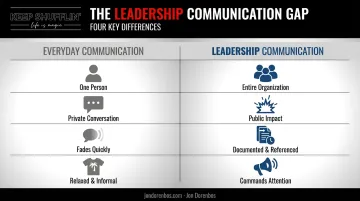
Leadership communication carries higher stakes than a casual chat with a coworker. Consider the differences:
- Multiple audiences at once — a message to frontline staff often needs to reach executives and the public simultaneously
- Direct business consequences: unclear direction can delay projects or tank morale
- Permanent record: emails and memos get forwarded, screenshotted, and referenced months later
- Amplified tone: a leader's offhand comment carries more weight than the same comment from a peer
The connection between this skill and organizational outcomes isn't theoretical. Gallup found that when employees strongly agree their leaders communicate clearly, build confidence in the future, and lead change effectively, 95% report full trust in leadership.
Compare that to Gallup's broader finding that only 21% of U.S. employees strongly trust organizational leadership overall. That's a 74-point gap, and it shows just how rare strong communication actually is among today's leaders.
Communication skill develops through practice and feedback, not natural talent. These five skills show exactly where to start.
The 5 Essential Communication Skills Every Leader Needs
Active Listening
Most leaders talk more than they listen. It happens naturally, since leaders spend years being expected to have the answers. Reversing this habit takes practice:
- Paraphrase back what you heard before responding ("So what you're saying is...")
- Ask open-ended questions instead of ones that invite a yes or no
- Pause before replying — three seconds of silence feels awkward but signals you're actually processing, not just waiting for your turn
A Workplace Intelligence study found that 63% of employees said their voice had been ignored in some way by a manager or employer, and 86% felt people at their organization weren't heard fairly. That's a trust problem hiding in plain sight.
Clarity & Directness
Lead with the point. Then add context if needed. Too many leaders bury the "one big thing" under three paragraphs of throat-clearing, leaving employees to guess what actually matters.
- State the decision or ask first
- Skip jargon that only makes sense inside your head
- Resist the urge to over-explain every nuance upfront
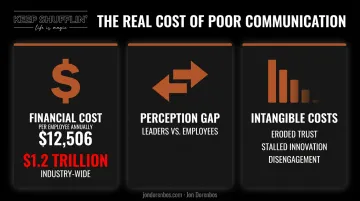
That $1.2 trillion cost mentioned earlier, and roughly $12,506 per employee annually, isn't limited to any one cause. But unclear messaging is consistently named as a top driver of wasted time across teams.
Empathy
Before jumping into problem-solving mode, acknowledge how someone feels. This matters most during change, conflict, or bad news, when people need to feel heard before they can absorb information.
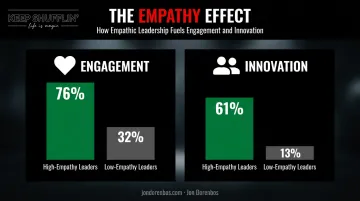
Catalyst's research on this is striking: employees with highly empathic senior leaders reported 76% engagement, compared to just 32% among those with less empathic leaders. Innovation followed a similar pattern, 61% versus 13%. Empathy functions as a performance lever here, driving both engagement and innovation.
Adaptability
The same message needs different packaging depending on who's receiving it. A board update, a frontline team huddle, and a public statement about the same news require three different approaches.
Example: announcing a restructuring might mean a data-heavy email for executives, a face-to-face conversation with direct impact for frontline employees, and a short, reassuring note for public-facing channels. Same facts, different delivery.
Transparency & Trust
Trust builds when words match actions, consistently, not just when things are going well. Leaders who share bad news proactively (not just good news) earn credibility that pays off later.
This ties directly back to that Gallup trust bundle mentioned earlier. Leaders who communicate consistently, even through rocky periods, see dramatically higher trust scores than those who only communicate when it's convenient.
Storytelling: The Leadership Communication Superpower
Facts inform. Stories stick. Leaders who rely purely on bullet points and data often watch their message evaporate within a day.
Storytelling works because it does something spreadsheets can't: it creates emotional connection. A well-told story clarifies vision, models vulnerability, and replaces corporate-speak with something people actually remember and repeat.
Jon Dorenbos, a former NFL long snapper turned keynote speaker, builds his entire presentation style around this principle. His story, from childhood tragedy through 14 years in the NFL to emergency heart surgery and a finalist run on America's Got Talent, isn't delivered as a straight narrative.
He weaves expert magic into the story itself, using sleight-of-hand as a live metaphor for resilience and reframing adversity. The magic doesn't interrupt the message. It reinforces it.
That combination sticks with audiences because it's lived experience, made visible in real time.
A Practical Starting Point for Leaders
You don't need a magic trick to apply this. You need a narrative with structure:
- Identify a real challenge you faced, professionally or personally
- Pinpoint the turning point — the moment something shifted
- Name the lesson you took from it
- Connect it explicitly to a value or goal your organization cares about
Skip the polished, safe version. The rawer the story, the more it lands.
The Real Cost of Poor Leadership Communication
Here's a gap worth sitting with: leaders consistently believe they're communicating well, while employees, more often than not, disagree.
- Financial cost: That earlier figure, roughly $12,506 lost per employee annually and up to $1.2 trillion industry-wide, isn't theoretical; it's built from real survey data on lost hours and productivity.
- Perception gap: Leaders frequently overestimate how clearly their message landed, while employees report confusion or ambiguity about the same communication.
- Intangible costs: Eroded trust, stalled innovation, and quiet disengagement don't show up on a balance sheet immediately. They compound.
The danger with intangible costs is that they're invisible until they aren't. A team that stops raising concerns because nobody listened last time doesn't announce it. They just go quiet, and productivity follows.
Building These Skills Across Your Leadership Team
Individual leaders can improve on their own, but organizations that build this skill across every level see broader results. A few proven approaches:
- 360-degree feedback: Best practice frames this as a developmental tool focused on two or three specific growth areas, not a performance evaluation
- Communication self-assessments: help leaders identify blind spots before they become patterns
- Coaching: targeted, ongoing support beats a single workshop every time
Experiential learning deserves particular attention here. ATD research found that 75% of organizations use experiential learning in leadership development, and high-performing organizations were nearly three times more likely to rely on it than lower performers.
This is where shared experiences make the difference. A keynote event or leadership offsite, where a speaker models authentic storytelling live, reinforces lessons in ways slide decks never will.
Jon Dorenbos has delivered this kind of experience for Fortune 500 companies including Apple, Marriott, and Kroger. His own story of resilience makes communication lessons tangible for entire rooms of leaders at once.
The goal isn't a single training event. Treat communication as an ongoing practice, with regular check-ins, not a box to check once a year.
Frequently Asked Questions
What is communication as a leadership skill?
It's the ability to inform, align, and inspire others through verbal, nonverbal, and written means, spanning one-on-one feedback to company-wide vision-setting. It applies at every level, regardless of title.
What are the 5 important communication skills for leaders?
Active listening, clarity and directness, empathy, adaptability, and transparency form the core five. Together, they cover how leaders receive, deliver, and build trust around information.
Can leadership communication skills be learned, or are some people just born better communicators?
Communication is learnable, not an innate trait. Consistent feedback, coaching, and repetition build these skills over time, regardless of starting point.
What is the most common leadership communication mistake?
Talking more than listening, or assuming a message was understood without confirming it. Both create silent gaps between what leaders think they communicated and what employees actually absorbed.
How does storytelling improve leadership communication?
Storytelling creates emotional connection and makes messages memorable in ways pure data rarely does. It helps leaders model authenticity instead of relying on corporate-speak.
How can a keynote speaker help improve a team's communication skills?
A keynote speaker who shares a genuine story, like Jon Dorenbos's journey from childhood tragedy to an NFL career, models vulnerability and resilience in ways teams remember. Employees carry that lesson back into daily conversations long after the event ends.