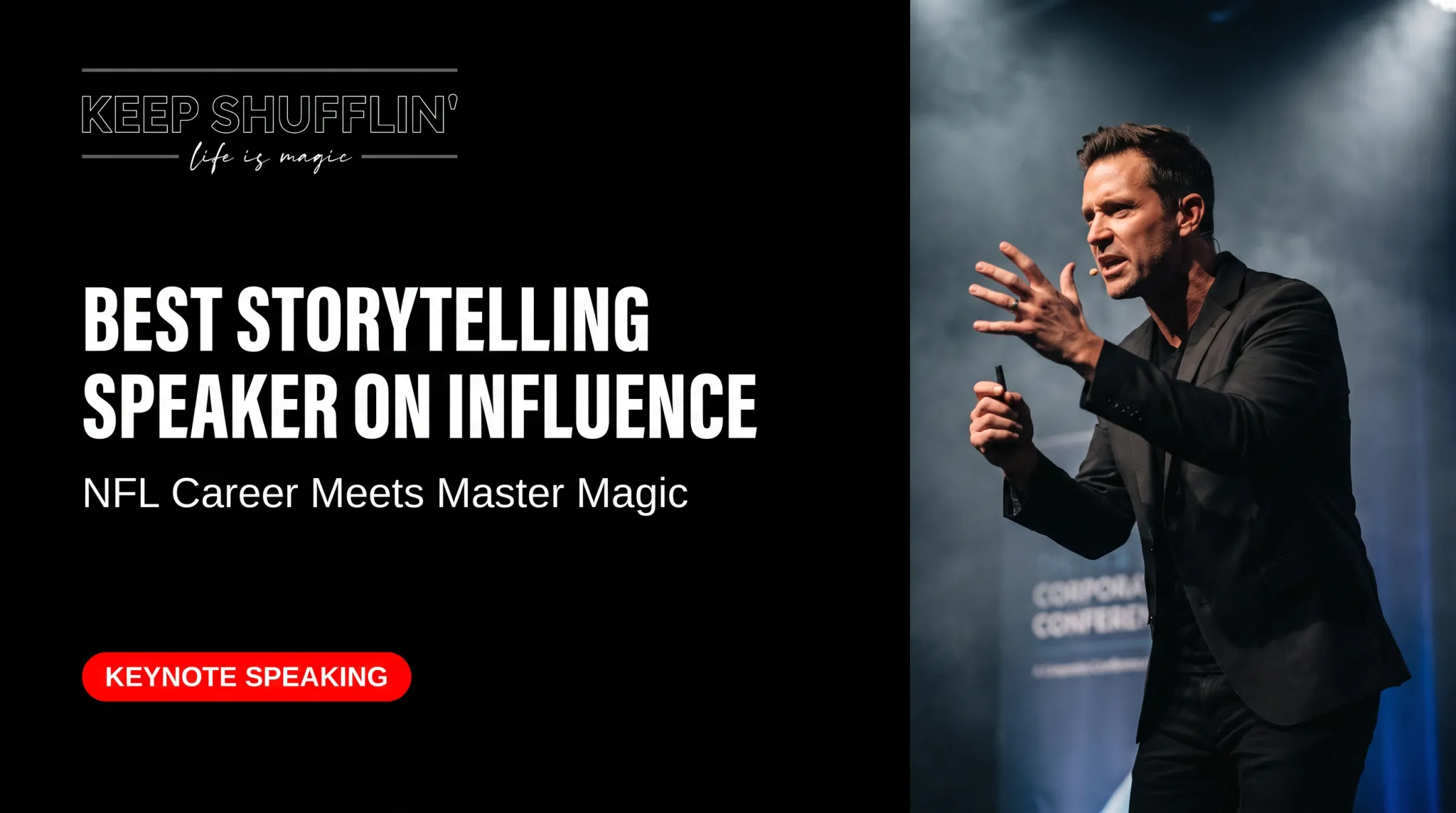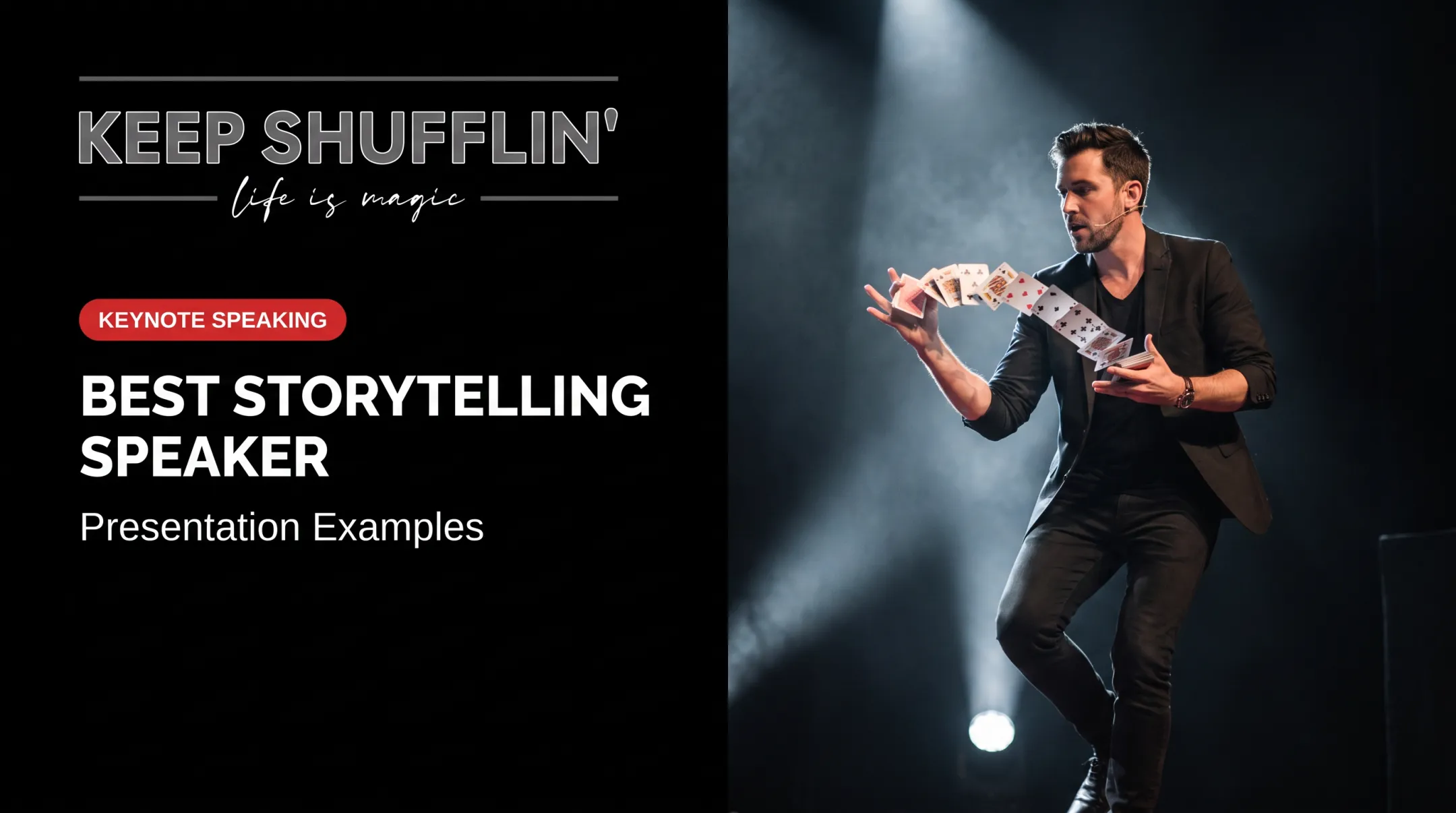

Storytelling has become the top-requested keynote skill because audiences are tired of slide decks and generic pep talks. They remember stories. Stanford marketing professor Jennifer Aaker has noted that stories can be up to 22 times more memorable than facts or figures alone.
The best storytelling speakers do more than perform. They blend personal narrative, real emotional stakes, and a takeaway audiences carry back to their desks. This guide breaks down what makes storytelling actually work on a corporate stage, profiles the speakers doing it best, and shows you how to pick the right one for your event.
TL;DR
- Storytelling for impact uses narrative, not data alone, to move audiences and inspire action
- Top speakers combine authenticity, vulnerability, humor, and a clear takeaway that sticks after the event
- Jon Dorenbos stands out for blending magic with a resilience and forgiveness story that drives lasting impact
- Choosing the right speaker comes down to audience fit, message alignment, and a proven track record
What Is Storytelling for Impact?
Storytelling for impact means structuring a message around conflict, a turning point, and resolution, the same bones every great story has had since campfires were the only stage. The goal is emotional resonance that shifts how people think or act once they leave the room.
Corporate audiences respond to lived experience far more than they respond to charts. Harvard Business School Online explains that hearing a story engages language comprehension, emotional response, and empathy-related brain processes simultaneously. This makes the information far more likely to stick in long-term memory than a bullet-pointed slide ever could.
That's the theory. But theory only lands when the person on stage can deliver it. The caliber of the speaker determines whether a story inspires a standing ovation or falls flat.
Qualities That Make a Storyteller Truly Impactful
Audiences can tell the difference between a polished story and a genuinely lived one within about thirty seconds. Authenticity and vulnerability aren't optional extras. They're the foundation. A speaker reciting a rehearsed anecdote sounds like a speaker reciting a rehearsed anecdote. A speaker reliving something real sounds like something else entirely.
The second non-negotiable is structure. Every impactful keynote follows a clear arc—stakes, tension, a turning point, and a resolution that lands in the audience's world, not just the speaker's.
Qualities of a Good Storyteller
Five qualities separate a memorable storyteller from a forgettable one:
- Authenticity — the story is lived, not borrowed or exaggerated
- Emotional intelligence — reading the room and adjusting tone in real time
- Clear structure — a beginning, a real obstacle, and a resolution
- Adaptability — customizing content to the specific audience and industry
- A strong call to action — leaving people with something to actually do
The 5 C's of a Story
Several communication experts have proposed frameworks for building a compelling narrative. One useful synthesis, drawing on frameworks like Jason Shen's 5C model, covers:
- Character — the protagonist the audience roots for
- Conflict — the obstacle standing in the way
- Change — how the character grows or transforms
- Context/Consequence — the stakes and setting that make it matter
- Call to action — the takeaway the audience carries out the door

Strong speakers don't recite these elements like a checklist. They weave them until the structure disappears and only the story remains. That is why lived arcs—an NFL career built after childhood tragedy, a public recovery, a message shaped for the room—land harder than borrowed anecdotes. When you evaluate a storytelling keynote speaker, listen for whether the 5 C's feel lived or assembled.
Top Storytelling Speakers Making a Real Impact
Choosing a storytelling speaker who creates real impact comes down to four criteria, not follower counts or fame:
- Authenticity of the personal story
- Stage presence
- Audience testimonials
- A documented corporate booking history
Jon Dorenbos
Jon Dorenbos spent 14 years in the NFL, 11 of them with the Philadelphia Eagles, winning a Super Bowl and earning two Pro Bowl selections as a long snapper. But his story starts earlier and darker: at age 12, his father murdered his mother, and Jon spent roughly a year in foster care before moving in with an aunt in Southern California.
His NFL career ended when a routine physical for the New Orleans Saints uncovered a heart condition requiring emergency open-heart surgery. That turning point pushed him toward magic and speaking full-time. He went on to become a finalist on America's Got Talent and AGT: The Champions, and appeared on The Ellen Show 25 times.
Why he stands out: Dorenbos doesn't do a magic show with a motivational intro tacked on. He builds the organization's actual message into the illusion itself.
In one keynote, he used a card trick to physically demonstrate a client's conference slogan, "get on the same page." Marriott International's Director of B2B Marketing and Events called him "the most powerful, engaging, dynamic and authentic presenter" in 17 years of producing events.
| Focus | Detail |
|---|---|
| Signature Story Theme | Resilience, forgiveness, and finding purpose after tragedy |
| Presentation Style | Magic-driven storytelling customized to each organization's message |
| Notable Clients | Apple, Marriott, Kroger, Facebook, RE/MAX, Hard Rock, Campbell Soup Company |

Kindra Hall
Kindra Hall built her career as a Chief Storytelling Officer before turning storytelling into a corporate keynote practice of her own. She's the author of Stories That Stick and Choose Your Story, Change Your Life.
Why she stands out: Her focus is strategic storytelling for business outcomes — sales, marketing, and leadership — rather than pure inspiration. That makes her a strong fit for revenue-focused events.
| Focus | Detail |
|---|---|
| Signature Story Theme | Strategic storytelling to build consensus and inspire action |
| Presentation Style | Energetic, actionable, delivered onstage or virtually |
| Notable Clients | AT&T, AON, Oracle, HP, Genentech |
Mike Robbins
Mike Robbins played professional baseball after Stanford and now draws on that athletic background for lessons on trust, teamwork, and appreciation.
Why he stands out: His warmth and candor come through in stories about why some teams thrive and others don't, backed by practical exercises audiences can use immediately.
| Focus | Detail |
|---|---|
| Signature Story Theme | Authenticity, trust, and teamwork drawn from pro sports |
| Presentation Style | Warm, candid, humor-driven with interactive elements |
| Notable Clients | Google, Microsoft, Walmart, Disney, LinkedIn |
Susan Lindner
Susan Lindner brings an unusual background: she worked as an anthropologist and aid worker in rural Thailand before founding Innovation Storytellers.
Why she stands out: Her international field experience gives her narratives on communicating ideas across cultures and hierarchies real texture, which resonates with global leadership teams.
| Focus | Detail |
|---|---|
| Signature Story Theme | Communicating innovation and ideas across organizational silos |
| Presentation Style | Anthropological, cross-cultural, leadership-focused |
| Notable Clients | GE, Corning, Citi, AT&T |

How to Choose the Right Storytelling Speaker for Your Event
The most common mistake companies make? Booking based on fame instead of fit. A celebrity name fills seats, but if the story doesn't connect to the audience's actual challenges, the impact evaporates by Monday morning.
To prevent that mismatch, Meeting Professionals International recommends defining your event's objectives in writing before you even start looking at speakers, then using that document as your filter.
Weigh these factors before booking:
- Message alignment — does the speaker's story connect naturally to your theme, or will it feel bolted on?
- Past client feedback — ask for references, not just testimonial quotes on a website.
- Customization ability — will they learn about your organization, or deliver the same talk everywhere?
- Proven audience impact — standing ovations, repeat bookings, and specific outcomes matter more than polish alone.

Jon Dorenbos puts that alignment into practice. His team builds each keynote around the client's mission rather than a generic inspirational arc. That approach is why organizations like RE/MAX and Marriott have brought him back repeatedly.
Conclusion
The best storytelling speaker is the one whose personal narrative matches what your audience needs to hear—and act on—next.
Look past the entertainment value. Ask what happens to culture, morale, or sales performance three months after the applause fades. That's the real measure of impact.
If your team needs a keynote built around resilience, forgiveness, or turning adversity into performance, Jon Dorenbos is a strong fit for your next conference or corporate event.
Frequently Asked Questions
What is storytelling for impact?
It's narrative-driven communication designed to create emotional connection and inspire action rather than simply inform. It uses conflict, a turning point, and resolution to make a message memorable.
What are 5 qualities of a good storyteller?
Authenticity, emotional intelligence, clear structure, adaptability to the audience, and a strong call to action. Missing any one of these tends to weaken the overall impact.
What are the 5 C's of a story?
Character, Conflict, Change, Context/Consequence, and Call to action. Professional speakers apply these elements so the structure feels invisible, not formulaic.
How much does it cost to book a keynote storytelling speaker?
Industry keynote fees often fall between $5,000 and $50,000, depending on profile and event size. Celebrity-tier speakers command substantially higher fees—contact the team directly for a customized Jon Dorenbos quote.
What makes Jon Dorenbos different from other motivational speakers?
He blends 14 years of NFL experience, stage magic, and a personal story of childhood tragedy and forgiveness into one performance. Every illusion is designed to reinforce the client's actual message.
How do companies measure the impact of a keynote speaker?
Most rely on post-event surveys measuring relevance and applicability, along with observed shifts in engagement or morale. Some also track alignment with the event's stated goals over the following months.