
Introduction
Your team is looking at you. The restructuring just got announced, the strategy just shifted, or the market just moved — and every face in the room is asking the same silent question: Do you know where we're going?
Most leaders dread that moment. Not because they lack competence, but because leading through genuine uncertainty is categorically different from leading when things are stable and predictable.
According to Prosci's research, projects with extremely effective sponsors were 79% likely to meet their objectives, compared to just 27% for those with ineffective sponsors. Leadership engagement during change isn't a soft factor — it's the primary determinant of whether a transformation succeeds or stalls.
This article breaks down what change leadership actually means, why it demands more than everyday leadership, and what concrete strategies help leaders guide their teams through disruption — even when the full picture hasn't come into focus yet.
Key Takeaways
- Change leadership focuses on the human and behavioral side of transformation — not just the operational mechanics
- Only 18% of leaders feel very prepared to lead through change, according to DDI's Global Leadership Forecast
- Trust, transparency, and clear communication are the foundation of effective leadership during uncertainty
- Resistance to change is predictable and addressable — the best leaders anticipate it rather than react to it
- A leader's internal narrative under pressure shapes how their entire team experiences that pressure
What Is Change Leadership — and Why Does It Differ from Change Management?
Change leadership is the ability to set direction, inspire behavioral change, and guide people through transitions — whether triggered by internal restructuring, external market forces, or unexpected disruption.
It's not the same as change management.
Change Management vs. Change Leadership
| Dimension | Change Management | Change Leadership |
|---|---|---|
| Focus | Systems, timelines, plans | People, mindset, behavior |
| Primary question | How do we get from A to B? | Why will people believe in B? |
| Core tool | Process frameworks | Trust and communication |
| Failure mode | Missed milestones | Lost buy-in |
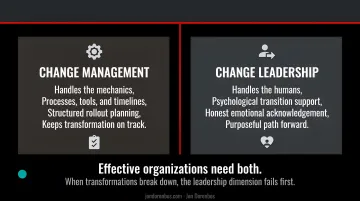
Change management handles the mechanics. Change leadership handles the humans. The most effective organizations need both. When transformations break down, the leadership dimension typically fails first.
Change leadership is people-centric at its core. It requires leaders to understand how transitions affect individuals psychologically, acknowledge those emotional responses honestly, and help people find a path forward that feels purposeful — not imposed.
Why Leading Through Uncertainty Is Harder Than Everyday Leadership
Most leaders are trained for steady-state conditions. Leading through genuine uncertainty demands a different skill set — one most organizations haven't developed.
DDI's Global Leadership Forecast, which surveyed approximately 13,000 leaders across 1,500 organizations, found that only 18% of leaders feel very prepared to lead through change. Separate simulation assessments of more than 100,000 leaders found that just 8% of executives demonstrated strong change leadership capability.
Those numbers aren't surprising when you consider what change actually demands of a leader:
- Projecting confidence without false certainty — teams need direction, not pretend answers
- Managing personal stress while supporting others — leaders absorb anxiety from above and below simultaneously
- Communicating clearly when information is still incomplete — waiting for certainty often means waiting too long
- Maintaining credibility when outcomes are genuinely unknown
Change also amplifies existing leadership gaps. Gallup's nationally representative survey of 18,665 U.S. employees found that employees experiencing significant disruption who strongly trusted organizational leadership were 4.5 times as likely to be engaged and 62% less likely to report frequent burnout.
The pressure is highest on leaders themselves — Gallup found that leaders and managers were 56% more likely than individual contributors to experience extensive disruption. The leaders expected to stabilize their teams are facing the most disruption themselves — which is exactly why change leadership capability can't be treated as a secondary skill.
The Mindset That Separates Effective Change Leaders
The leaders who navigate uncertainty best share one thing: they've shifted how they relate to it.
Proactive vs. Reactive Posture
Stephen Covey's concept of the Circle of Influence vs. Circle of Concern applies directly here. During disruption, reactive leaders pour energy into concerns outside their control — market conditions, decisions made above them, economic headwinds. Proactive leaders redirect that energy toward what they can influence: how they communicate, how they show up, how they help their team adapt.
This isn't optimism as a performance. It's a deliberate choice about where to focus.
The Internal Narrative as a Leadership Tool
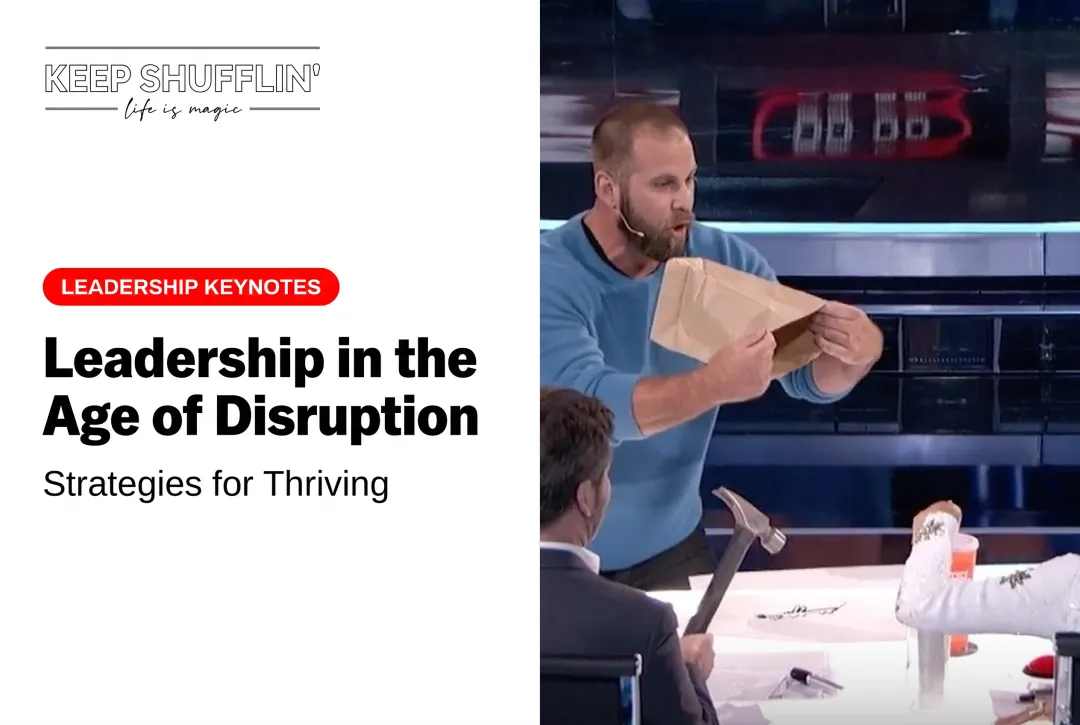
The conversations leaders have with themselves under pressure directly shape how they show up for their teams. Jon Dorenbos — former Philadelphia Eagles long snapper, America's Got Talent finalist, and survivor of life-threatening open-heart surgery — puts it plainly: "You write your own script. The words we tell ourselves determine the life we live."
His journey from childhood tragedy to 14 years in the NFL to surviving emergency heart surgery at the peak of his career is a live case study in this principle. The internal narrative is a leadership tool, not just a personal development concept. Leaders who tell themselves a story of powerlessness create teams that feel powerless. Leaders who reframe uncertainty as navigable give their teams permission to engage rather than withdraw — because leading yourself through uncertainty is the prerequisite to leading anyone else through it.
Growth Mindset in Practice
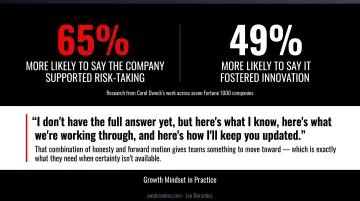
Research from Carol Dweck's work across seven Fortune 1000 companies found that employees in growth-mindset organizations were 65% more likely to say the company supported risk-taking and 49% more likely to say it fostered innovation.
In a team setting, a growth mindset looks like a leader who says: "I don't have the full answer yet, but here's what I know, here's what we're working through, and here's how I'll keep you updated." That combination of honesty and forward motion gives teams something to move toward — which is exactly what they need when certainty isn't available.
Practical Strategies That Move Teams Forward During Change
Each of the following strategies addresses a different pressure point — from how you communicate to how you show up. Together, they give leaders a practical framework for maintaining trust and momentum when the path forward isn't fully mapped.
Communicate with Clarity, Not Certainty
Leaders often confuse having answers with communicating clearly. They're not the same thing.
Effective change communication means:
- Stating clearly what is known and decided
- Naming explicitly what is still being worked out
- Separating facts from speculation — and saying which is which
- Setting a cadence: "We'll share an update by Friday" and then doing it
The silence leaders leave when they don't have full answers gets filled — by rumor, assumption, and anxiety. Structured, honest updates prevent that.
Lead with Empathy as a Strategic Skill
Empathy during change isn't softness — it's what determines whether people stay engaged or quietly disengage.
A Catalyst survey of nearly 900 U.S. employees found that 76% of employees with highly empathic senior leaders reported engagement, versus just 32% with less empathic leaders. Innovation followed the same pattern: 61% vs. 13%.
Acknowledging the emotional weight of disruption — "I know this is hard and uncertain" — isn't a detour from leadership. That kind of honesty builds the psychological safety teams need to keep performing under pressure.
Involve Employees in the Response
Inclusion creates ownership. When employees help shape the response to change rather than just receive it, resistance drops.
McKinsey's analysis of 60 publicly listed companies found that transformations where at least 7% of employees owned part of the transformation were twice as likely to produce above-benchmark shareholder returns.
Practical ways to create genuine involvement:
- Form cross-functional working groups to solve specific implementation challenges
- Run structured listening sessions where feedback shapes decisions, not just informs them
- Give teams visible problems to own — even small ones — early in the process
Keep Roles and Expectations Crystal Clear
Ambiguity fuels anxiety. During restructuring or strategic pivots, many team members burn significant mental energy wondering whether their job is safe, what their new responsibilities are, and what success looks like now.
Leaders who proactively clarify roles after each phase of change and set measurable expectations reduce that burden. The goal isn't to promise stability — it's to create clarity within instability.
Model the Behavior You're Asking For
Teams watch their leaders during change more closely than at any other time.
Walking the talk means:
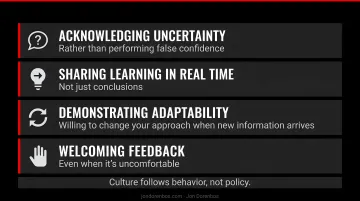
- Acknowledging when you're uncertain, rather than performing false confidence
- Sharing what you're learning in real time — not just conclusions
- Demonstrating adaptability: being willing to change your approach when new information arrives
- Welcoming feedback even when it's uncomfortable
Culture follows behavior, not policy. When leaders model curiosity and openness under pressure, teams take the cue — and that makes the difference between an organization that stalls during change and one that adapts through it.
How to Address Resistance Without Making It Worse
Why Resistance Happens
Resistance to change isn't a character flaw — it's a behavioral reality. Research on status quo bias, established by Samuelson and Zeckhauser, shows that decision-makers disproportionately prefer existing arrangements, even when alternatives are objectively better. Change asks people to move away from something familiar before they can see what's on the other side.
According to Gartner, 79% of employees had low trust in change, and only 32% of mid- to senior-level leaders said their last change achieved healthy adoption without undue stress or performance damage.
A Practical Framework for Diagnosing Resistance
The most common sources of resistance map to three distinct causes — each requiring a different leadership response:
| Root Cause | What It Looks Like | Leadership Response |
|---|---|---|
| Confusion about the "why" | Questions, skepticism, disengagement | Clearer purpose communication |
| Fear of loss | Anxiety about role, status, or security | Honest dialogue and acknowledgment |
| Lack of trust in leadership | Cynicism, passive compliance | Consistent follow-through over time |
Getting the diagnosis right matters. Responding to fear of loss with more information doesn't address what people are actually feeling — acknowledgment does.
Once you've diagnosed the resistance accurately, the next challenge is sustaining forward movement — and that's where early wins become critical.
The Role of Quick Wins
Early, visible signs of progress do more to build momentum than almost any communication strategy.
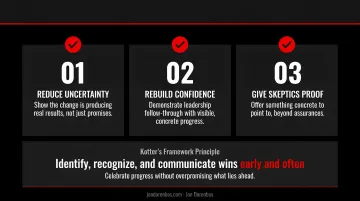
As Kotter's framework describes, short-term wins should be identified, recognized, and communicated early and often.
Quick wins serve three functions:
- Reduce uncertainty by showing the change is producing real results
- Rebuild confidence in leadership through demonstrated follow-through
- Give skeptics something concrete to point to, not just assurances
Leaders who deliberately identify and celebrate early progress, without overpromising on what's still ahead, keep momentum alive through the difficult middle stretch of any major change effort.
Building a Culture Where Adaptability Becomes the Default
The ultimate goal of change leadership isn't surviving one transition. It's building a team and culture that meet the next one from a position of readiness rather than dread.
Prosci's maturity research shows that 54% of organizations remain at the two lowest levels of change management maturity — meaning change is handled reactively, without consistent standards or leadership expectations. Only around 11-14% of organizations reach the highest maturity levels, where adaptability is embedded in culture.
The leaders who close that gap share these habits:
- Run check-ins that surface concerns before they become crises, not just performance updates
- Create feedback loops where teams report what's working and what isn't — and then visibly act on that input
- Celebrate people who raise concerns early and propose solutions, not just those who comply quietly
External perspectives can accelerate what internal communication alone rarely achieves. Bringing in a speaker like Jon Dorenbos — whose story spans an NFL career, life-threatening surgery, and a performing career that reached millions — gives audiences a human model of resilience that sticks long after the event ends.
His keynotes at leadership summits and company-wide events are built to align teams around a shared experience, creating the emotional and psychological grounding that makes change feel navigable rather than threatening.
The goal isn't to eliminate uncertainty. It's to change the team's relationship with it — so that disruption triggers problem-solving, not paralysis.
Frequently Asked Questions
What are the 5 C's of change leadership?
One widely used framework covers five disciplines: Clarity, Communication, Courage, Commitment, and Collaboration. Together, these describe what leaders need during transition — from setting clear direction and communicating honestly, to making hard calls, staying committed through setbacks, and building shared ownership across the team.
Why is it more difficult to be a leader during times of change?
Uncertainty amplifies every leadership demand at once. Leaders must provide direction without complete information and manage their own stress while supporting others. All of this happens at precisely the moment team trust is most fragile. DDI found that only 8% of executives demonstrate strong change leadership capability — which reflects just how demanding this version of leadership actually is.
What is the difference between change leadership and change management?
Change management focuses on the structured process of moving an organization from one state to another — plans, timelines, workflows, and milestones. Change leadership focuses on the human and behavioral dimensions: inspiring belief in a new direction, building trust, and guiding people through the psychological experience of transition. Both are necessary; neither alone is sufficient.
What qualities make someone an effective change leader?
The most critical qualities are adaptability, empathy, clear communication under pressure, the ability to remain calm without projecting false certainty, and a willingness to model the behaviors being asked of others. Leaders who acknowledge uncertainty honestly while maintaining directional clarity tend to earn the most trust during difficult transitions.
How do you overcome employee resistance to change?
Start with early involvement — give employees a meaningful role in shaping the response, not just receiving it. Pair that with transparent communication about the reasons for the change, and then build trust through consistent follow-through on commitments.
How can storytelling and personal experience help leaders inspire teams through change?
Personal narratives of adversity overcome are among the most effective tools for shifting how people relate to uncertainty. When a leader — or a speaker brought in for a leadership event — shares an authentic story of navigating genuine loss and reinvention, it gives audiences a concrete, human model for what resilience looks like in practice. That shift from abstract concept to lived example is what drives real behavioral change.