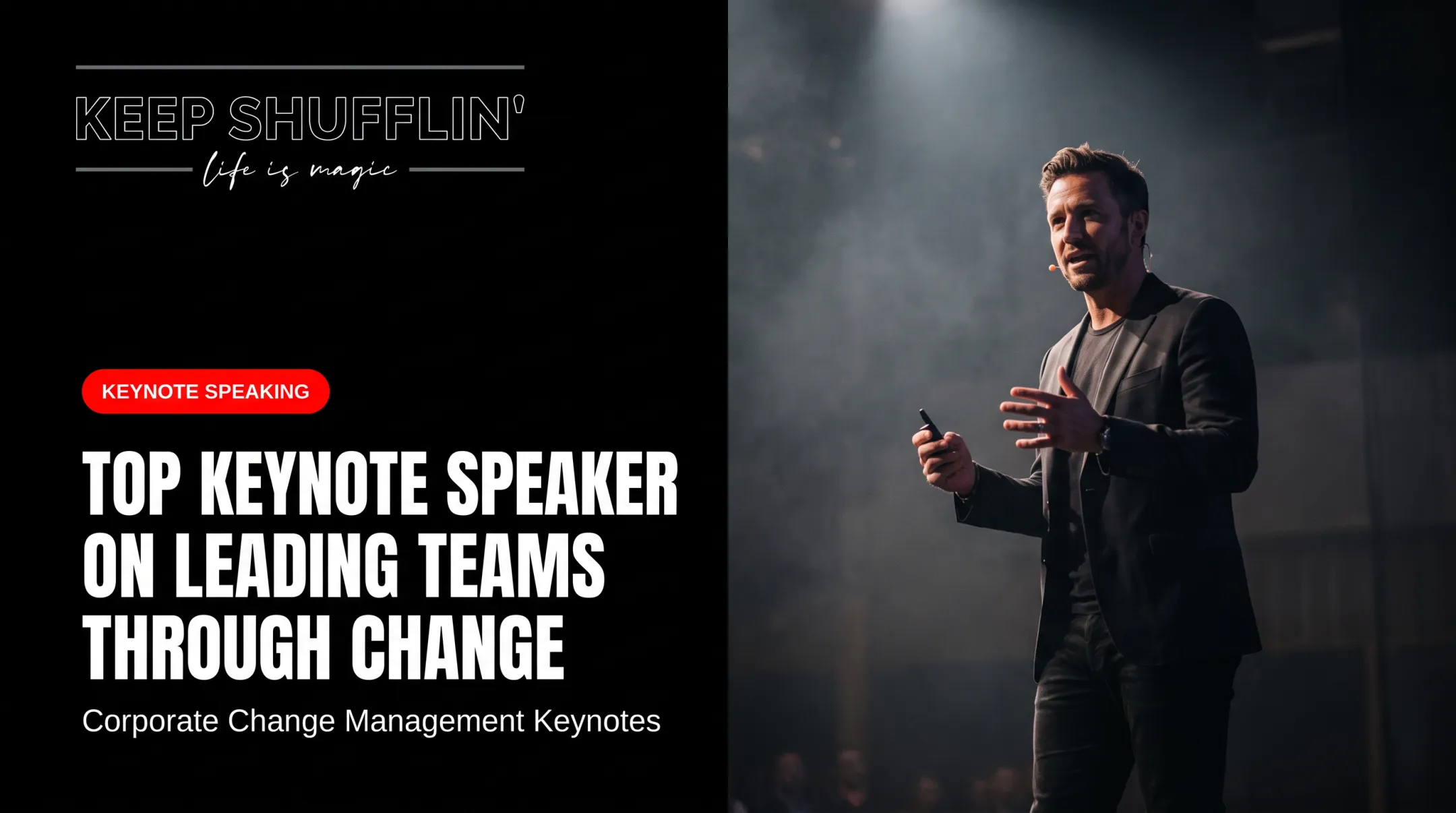

Here's the uncomfortable truth: only 32% of business leaders say their last change initiative achieved healthy employee adoption, according to a 2025 Gartner study. Even worse, 79% of employees report low trust in change efforts overall.
That gap is exactly why "leading through change" has become such a common request for conferences, sales kick-offs, and leadership summits. This guide breaks down what change leadership actually means, the frameworks worth knowing, and why the right keynote speaker can reset a team's mindset faster than any slide deck.
TL;DR
- Leading through change means guiding people emotionally, not just managing logistics
- Frameworks like Kotter's 8 Steps give structure, but mindset and storytelling drive real adoption
- Jon Dorenbos, former NFL long snapper and America's Got Talent finalist, delivers a keynote built on resilience and reinvention
- Choose a speaker whose personal story turns change into practical takeaways teams remember and use
What Does It Mean to Lead Through Change?
Change management is the process side: timelines, systems, communication plans. Change leadership is different. It's the human work of helping people believe change is necessary, survivable, and worth their effort.
Most organizations are still better at the first than the second.
The numbers back this up:
- McKinsey has long cited that roughly 70% of large-scale transformations fail to hit their goals
- Prosci found that projects with excellent change management met objectives 88% of the time, versus just 13% for projects with poor change management
- Only 32% of leaders reported healthy adoption from their most recent change effort

That's the readiness gap event planners are trying to close. A keynote focused on leading through change isn't a "nice to have" anymore. It's often the session designed to reset a room before a company rolls out a major restructuring, system change, or strategic pivot.
Popular Change Leadership Frameworks Leaders Should Know
Frameworks won't solve the trust problem on their own, but they give leaders a shared vocabulary. Here are the ones that come up most often.
Kotter's 8 Steps for Leading Change
Harvard Business School professor John Kotter built this model, and it's still the industry standard. The current 8-step sequence is:
- Create a sense of urgency
- Build a guiding coalition
- Form a strategic vision
- Enlist a volunteer army
- Enable action by removing barriers
- Generate short-term wins
- Sustain acceleration
- Institute change

It's sequential and logistics-heavy, which makes it useful for planning but limited for winning hearts and minds.
The 5 C's of Transformational Leadership
One widely used version, from Fielding Graduate University, names the five C's as Clarity, Connection, Creativity, Confidence, and Commitment:
- Clarity: Paint a realistic, honest picture of the future
- Connection: Tie people to purpose, not just tasks
- Confidence: Trust your capabilities in an unpredictable environment—not false certainty
- Creativity and Commitment: Unlock new options, then stick with the path long enough to matter

Those C's show up clearly in Alan Mulally's Ford turnaround. Brought in from Boeing in 2006 as Ford anticipated a $17 billion loss, he simplified the product portfolio, flattened the org structure, and rebuilt executive accountability around shared data. The company returned to profitability without a federal bailout.
7 Steps and 7 C's (Quick Reference)
INSEAD's Linda Brimm outlined a separate "Seven C's" cycle: Complexity, Clarity, Confidence, Creativity, Commitment, Consolidation, and Change. The heavy overlap with other models is the takeaway—leaders keep rediscovering the same human requirements under new labels.
Frameworks are maps, not motivation. People don't adopt change because a leader checked eight boxes. They adopt it when someone makes them believe it. That's where storytelling takes over.
Why Storytelling and Lived Experience Matter More Than Frameworks Alone
Here's a striking finding from a 2024 study in the Quarterly Journal of Economics: the impact of statistics on people's beliefs faded 73% within a day. The impact of a story faded only 32%.
Stories stick. Data doesn't, at least not on its own. The same gap shows up when change programs lean on frameworks without a human story behind them.
This is backed by trust research too. Gartner found employees are 4.3 times more likely to trust leaders who actually explain the reasoning behind decisions, rather than just announcing them.
That's why organizations bring outside voices into all-hands meetings and leadership retreats. A speaker with a real, lived transformation story can reinforce a change initiative in ways a slide deck of best-practice frameworks never will.
Jon Dorenbos: A Uniquely Powerful Voice on Leading Through Change
Few speakers embody unplanned, forced change quite like Jon Dorenbos.
At age 12, Dorenbos lost his mother when his father took her life. He spent a year in foster care before moving to Southern California to live with his aunt. Football and, unexpectedly, magic became his anchors during that period.
His path from there is the résumé of someone who kept reinventing himself:
- 14 years as an NFL long snapper, including two Pro Bowl selections and a Super Bowl win with the Philadelphia Eagles
- Life-threatening heart condition found in a 2017 check-up, requiring emergency open-heart surgery that ended his football career overnight
- A pivot into professional magic, leading to finalist runs on America's Got Talent and America's Got Talent: The Champions
- Regular appearances on The Ellen DeGeneres Show
- More than 1,000 event appearances for organizations including Marriott, Kroger, RE/MAX, Campbell Soup Company, Five Below, and Hard Rock

A Message Built Into a Performance
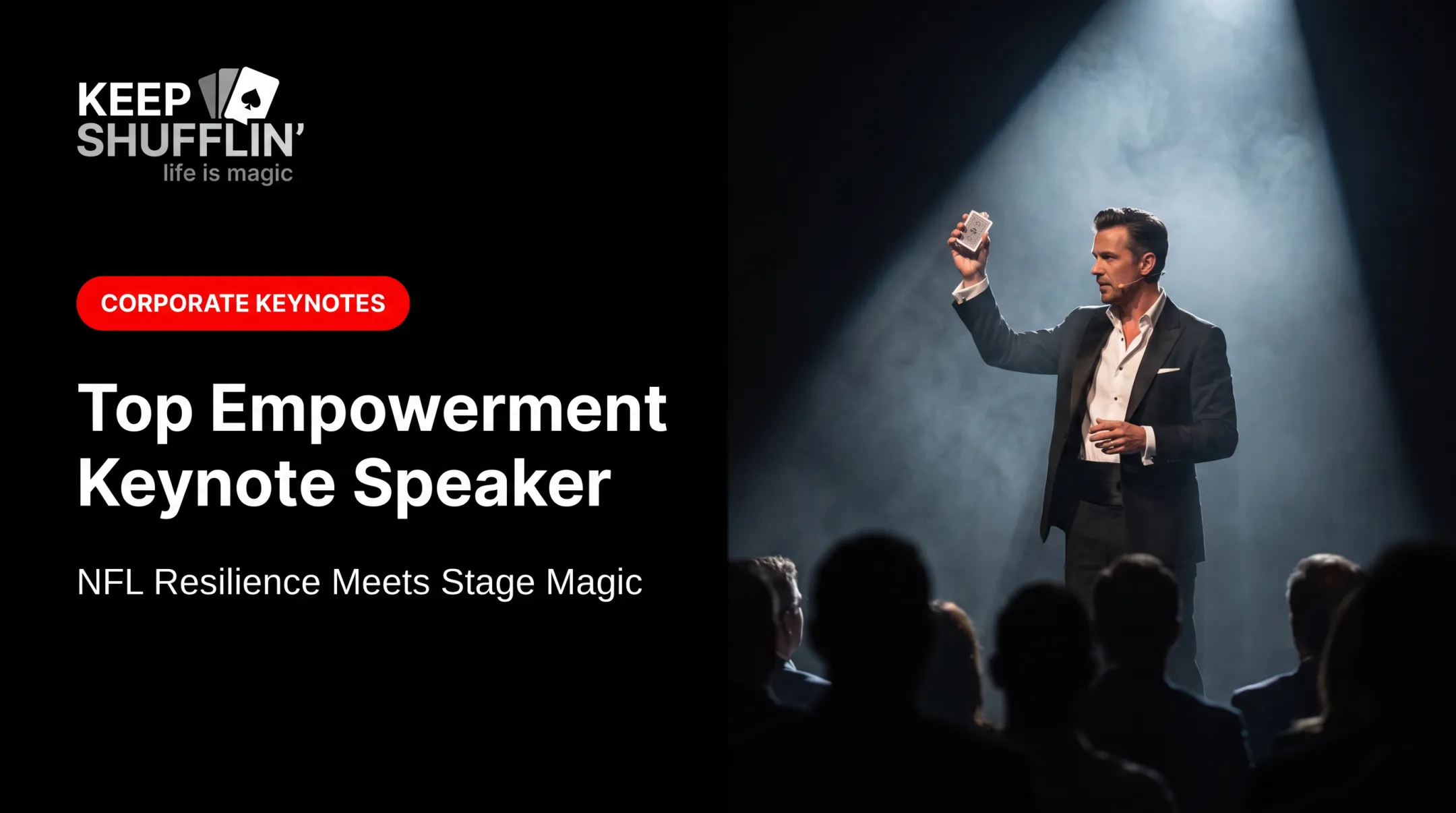
What sets Dorenbos apart is how he delivers that story. He weaves sleight-of-hand magic directly into his message, using card tricks as literal metaphors for reinvention and adaptability. One audience gave an unsolicited standing ovation halfway through, before he'd finished speaking.
Marriott's Michael Clark called a virtual session for over 3,400 employees and their families "AMAZING" and "a grand slam." RE/MAX's Nick Bailey named him the "BEST KEYNOTE SPEAKER" his organization has booked.
Presentations are customized to each client's change initiative, industry, and culture, not delivered as a generic script.
How to Choose the Right Speaker to Lead Your Team Through Change
Not every keynote speaker who talks about "resilience" is the right fit for a change-focused event. Here's what to evaluate:
- Authenticity over theory. Has the speaker lived through disruptive change themselves, or are they reciting frameworks from a slide?
- Real customization. Ask how their team gathers information about your industry and specific change challenge before building the talk.
- Engagement format. Does the session include interactive or memorable moments, or is it 45 minutes of straight talking?
- Track record with similar audiences. Fortune 500 experience, association events, sales conferences: look for relevant precedent.
Jon Dorenbos's team, for example, starts with a call to understand the organization's goals, industry challenges, and desired outcomes. They then shape the presentation around themes like embracing change, accountability, and self-talk.
Conclusion
Leading through change takes both structure and heart. Frameworks like Kotter's 8 Steps give leaders a plan. But mindset shifts happen through stories people can't stop thinking about.
If you're planning a leadership event, sales kick-off, or company meeting centered on change, you need more than a presenter. You need a speaker who can move a room.
Ready to bring that energy to your next event? Reach out to book Jon Dorenbos or call his manager, Tim Mooney, at +1 (609) 412-0746 to discuss customizing a keynote around your organization's change initiative.
Frequently Asked Questions
How do you lead through change?
Lead through change by communicating openly, showing empathy for how people are affected, setting a clear vision, and modeling adaptability yourself. People follow leaders who explain the "why," not just the "what."
What does it mean to lead through change?
It means applying human, emotional leadership, not just managing timelines and logistics. Change management handles the process; change leadership helps people believe the change is worth it.
What are Kotter's 8 steps for leading change?
Create urgency, build a coalition, form a vision, enlist volunteers, remove barriers, generate short-term wins, sustain acceleration, and institute the change. It's a sequential model from Harvard's John Kotter.
What are the 5 C's of transformational leadership?
One widely cited model (Fielding Graduate University) uses Clarity, Connection, Creativity, Confidence, and Commitment. Other sources define transformational leadership differently, so context matters.
Can you give me an example of transformational leadership?
Alan Mulally's turnaround at Ford is a classic case. He simplified the company's structure and product line and rebuilt trust through transparent, data-driven leadership during a near-bankruptcy crisis.
What are the 5 pillars of change management?
There's no single universal standard here. Prosci uses five core principles alongside its ADKAR model, while other firms define their own frameworks, so it's best to ask which source a "pillar" list references.