
Most organizers invest heavily in venue selection, catering logistics, and AV production. The strategic thinking behind who opens and how gets a fraction of that energy. The result: the slot with the highest audience energy and receptivity gets handed to the wrong speaker, with the wrong brief, for the wrong reasons.
This article breaks down the specific mistakes organizers make, what a genuinely effective opening keynote accomplishes psychologically, and how to select and brief a speaker who ignites the room from minute one.
Key Takeaways
- The opening keynote sets the energy for your entire event — every session that follows rises or falls with it
- The most common mistakes aren't budget problems; they're strategic ones rooted in misunderstanding what the opener must do
- Entertainment and inspiration aren't competing priorities — the best openers deliver both simultaneously
- Customization isn't optional; a canned speech that could play anywhere will feel hollow to the room
- Credentials earn a speaker a shortlist spot; proof of audience transformation earns them the stage
The Opening Keynote Sets the Temperature for Your Entire Conference
Attendees arrive distracted. They're travel-fatigued, still mentally processing yesterday's emails. The opening keynote's job isn't to inform them — it's to break that loop and pull them into the room psychologically.
The opener functions like an energy thermostat: whatever emotional temperature it sets, every subsequent session inherits. A flat open creates an uphill battle for every breakout speaker, panel moderator, and workshop facilitator that follows.
Opener vs. Closer: Two Completely Different Jobs
These two roles are often conflated, and the confusion causes real programming damage.
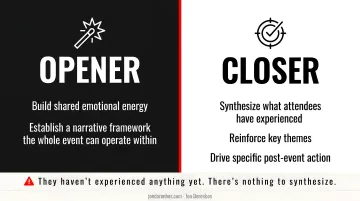
- Openers build shared emotional energy and establish a narrative framework the whole event can operate within
- Closers synthesize what attendees have experienced, reinforce key themes, and drive specific post-event action
Booking a "closer-style" speaker — heavy on summaries, action plans, and data synthesis — to open your conference leaves audiences feeling overwhelmed before the day has even started. They haven't experienced anything yet. There's nothing to synthesize.
What Attendees Actually Want
According to Cvent's account of the 2024 Freeman Trends Report, 38% of attendees want to leave a keynote better informed, while 35% want to feel inspired or motivated. A strong opener has to serve both groups — and the psychological groundwork for that starts in the first five minutes.
The Most Common Mistakes Conference Organizers Make With Opening Keynotes
Mistake 1: Booking for Name Recognition Instead of Audience Fit
Famous ≠ effective. Freeman attendee research reported by PCMA found that only 1% of attendees preferred celebrity speakers, while 37% preferred industry leaders or subject matter experts. A household name looks impressive in the conference brochure and produces polite applause in the room — but if the message doesn't connect to your audience's specific pressures and your event's theme, that applause is just courtesy.
Mistake 2: Treating the Opener Like a Warm-Up Act
Many organizers give the opening slot to an internal executive or a lower-priority speaker, saving the "big name" for later in the day. The logic sounds reasonable, but it isn't. The opening session catches attendees at their most physically present — they haven't been sitting through sessions for four hours yet. That's when their capacity for genuine engagement is highest. Wasting it on a placeholder speaker is a structural error you can't recover from.
Mistake 3: Skipping the Deep Briefing
Signing a speaker and sending over a one-page event summary is not a briefing process. Without genuine insight into your audience, even a world-class speaker delivers a talk that could have been given anywhere.
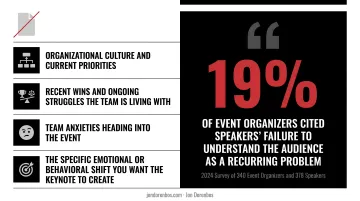
A real briefing goes deeper — it covers:
- Organizational culture and current priorities
- Recent wins and ongoing struggles the team is living with
- Team anxieties heading into the event
- The specific emotional or behavioral shift you want the keynote to create
A 2024 survey of 340 event organizers and 378 speakers found that 19% of organizers specifically cited speakers' failure to understand the audience as a recurring problem. That failure starts with an inadequate briefing.
Mistake 4: Confusing Information Delivery With Emotional Engagement
An opening keynote packed with frameworks, data, and case studies can be intellectually solid and emotionally flat at the same time. Audiences don't shift their psychological state in response to bullet points. Cognitive research consistently shows that emotionally resonant story moments shape what listeners actually retain — not the third framework slide. The opener must move people emotionally before it can move them intellectually. Information-first openings have the sequence backwards.
Mistake 5: Evaluating Speakers Only on Their Sizzle Reel
A 90-second highlight reel is curated marketing. The National Speakers Association is explicit that a speaker reel is built from selected clips specifically designed to attract bookings — it is not an unedited performance sample. What a reel cannot show you: how a speaker sustains a room's attention across 45–60 minutes, how they handle low energy in the first ten minutes, or whether their customization is genuinely woven into the narrative or awkwardly bolted on.
What an Unforgettable Opening Keynote Actually Accomplishes
It Breaks Attendees Out of Visitor Mode
The best openers create a moment — usually within the first few minutes — where the audience stops being observers and starts being participants. This happens through authentic storytelling that names the room's shared struggles, unexpected performance elements that generate genuine surprise, or interactive moments that require active engagement. Surprise matters: memory research suggests that expectation violations produce richer encoding, meaning audiences retain more from moments that catch them off guard.
It Plants a Theme the Whole Event Can Reference
The opener establishes a single emotional narrative — resilience, adaptability, purpose, growth — that every other session can point back to. When a closing speaker or breakout facilitator says "as we heard this morning," and the callback lands, that's not accidental. It's what happens when the opening keynote was strategically designed as the event's emotional anchor.
It Earns Trust Through Authenticity, Not Polish
Sophisticated audiences can detect the difference between a speaker who is performing and one who is sharing. Harvard Business Review frames this through the Trust Triangle: audiences need to perceive authenticity, feel that the speaker genuinely cares about them, and follow the logic of the argument. Speakers whose vulnerability feels real — not sanitized for corporate consumption — generate the standing ovations. The ones who hide behind credentials and production value generate polite applause.
It Blends Entertainment With Substance
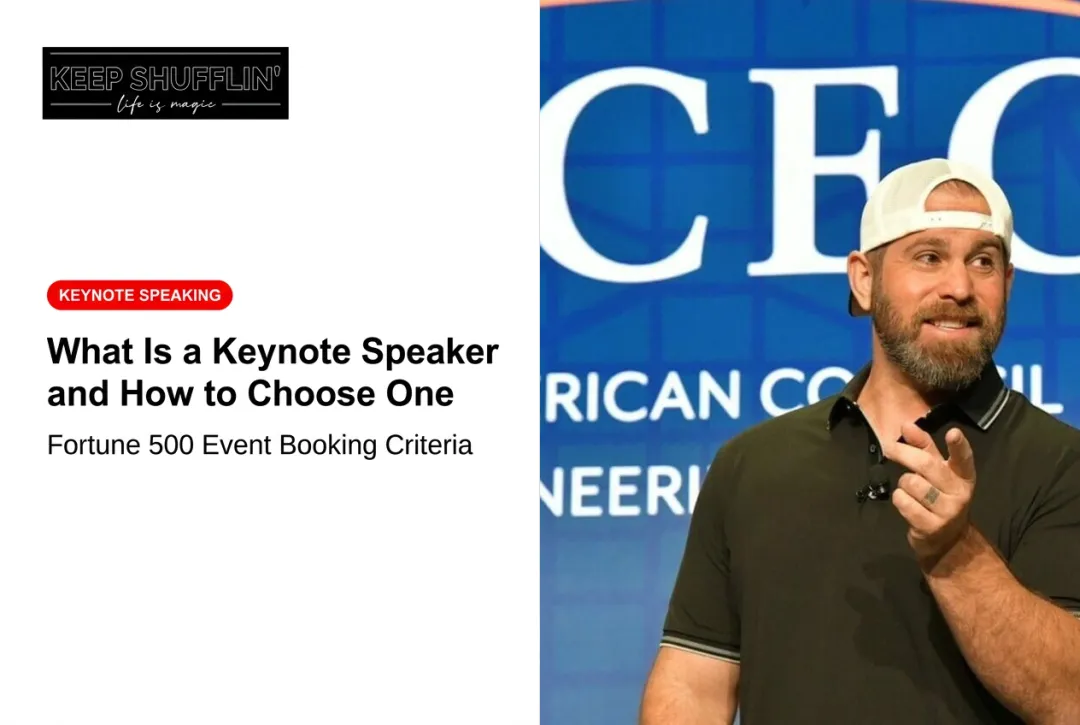
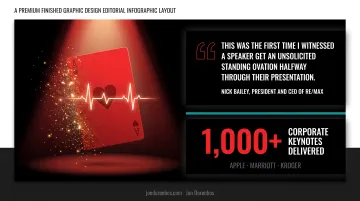
The most effective opening keynotes are inspirational and entertaining at once — treating the two as competing priorities is where planning goes wrong. Jon Dorenbos — who has delivered more than 1,000 corporate keynotes for companies including Apple, Marriott, and Kroger — uses world-class magic not as a spectacle but as a storytelling device. Each illusion serves as a metaphor: just as the trick challenges what an audience believes is possible, his personal story challenges the assumption that tragedy defines a person's future. The result isn't just a memorable hour. It's a shared emotional experience the room carries into every session that follows.
Nick Bailey, President and CEO of RE/MAX, described it plainly: "This was the first time I witnessed a speaker get an unsolicited standing ovation halfway through their presentation."
That kind of response doesn't happen by accident. It's the product of a keynote designed to do something specific before it ends.
It Ends With One Clear Idea
The final moments of an opener shouldn't dissolve into applause and a logistics announcement. The room needs a single, memorable idea or challenge they carry into every session for the rest of the day. One clear takeaway (not five) that surfaces in conversations over lunch and gets referenced in the closing remarks.
How to Vet and Choose the Right Opening Keynote Speaker
Credentials Are the Starting Point, Not the Finish Line
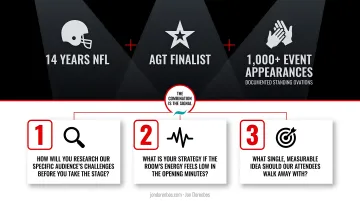
An impressive biography — NFL career, national TV appearances, Fortune 500 client list — tells you a speaker can command a room. It doesn't tell you whether they can command your room. Jon Dorenbos's background (14 years in the NFL, America's Got Talent finalist, 1,000+ event appearances with documented standing ovations) matters not because any single credential is definitive, but because the combination signals reliability, range, and proven impact across wildly different audience types. That combination is the signal. Any one element in isolation is not.
Before booking, ask three questions that separate stage performers from genuine transformational speakers:
- "How will you research our specific audience's challenges before you take the stage?"
- "What is your strategy if the room's energy feels low in the opening minutes?"
- "What single, measurable idea should our attendees walk away with?"
Vague answers to these questions are as informative as clear ones.
Watch Full-Length Recordings, Not Highlights
Request a complete 45–60 minute recording of a recent keynote from a comparable event. As you watch, look for:
- Pacing through the middle third — that's where most speakers lose the room
- Recovery from low-energy moments — how they read and respond to a disengaged crowd
- Depth of customization — whether audience-specific material feels woven into the narrative or bolted on as obvious annotations
Beyond the recording, have a direct conversation with the speaker or their team before signing. Pay attention to whether they ask smart questions about your audience, your culture, and your desired outcome. A speaker who leads with pitching their existing talk — rather than asking about yours — will almost certainly deliver that same generic talk on your stage.
Briefing Your Speaker for Maximum Impact
A thorough speaker brief is the operational foundation of a tailored keynote. A one-page summary produces a generic talk. A detailed brief produces a keynote that feels written specifically for your audience.
Your brief should include:
- Recent organizational wins and current team anxieties
- The specific event theme and what it means to this audience
- What the audience is nervous about, excited about, or resistant to
- The single emotional outcome you want the audience to carry into the rest of the day
- Cultural references, internal language, or milestones that will resonate with this specific group
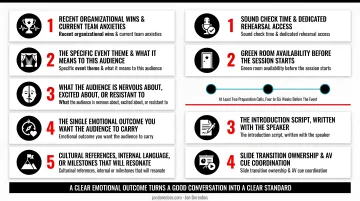
Plan for at least two preparation calls four to six weeks before the event. Let the speaker do most of the talking — it's the fastest way to gauge how well they've absorbed your context.
Logistics details organizers consistently underestimate:
- Sound check time and dedicated rehearsal access
- Green room availability before the session starts
- The introduction script — which should be written in collaboration with the speaker, not improvised by the MC
- Slide transition ownership and AV cue coordination
Getting these logistics right isn't separate from the brief — it's an extension of it. When the speaker knows the specific emotional outcome you're working toward, post-event evaluation becomes measurable rather than subjective. That's what turns a good conversation into a clear standard.
Frequently Asked Questions
Frequently Asked Questions
How far in advance should a conference organizer book an opening keynote speaker?
For premium or in-demand speakers, aim for 6–12 months ahead. Cvent's own events team reports beginning keynote conversations seven months out, particularly for C-suite-adjacent speakers whose calendars fill quickly. Earlier booking also gives you more lead time for the briefing process, which directly improves the final presentation.
Should an opening keynote speaker be motivational or educational?
The best openers do both. Effective opening keynotes blend emotional resonance with actionable insight, priming the audience psychologically while giving them a framework to carry through the day. Purely motivational opens evaporate by lunch; purely educational ones never connect in the room.
What is the difference between an opening keynote and a closing keynote?
An opener builds vision, energy, and shared emotional context. A closer synthesizes key themes and drives specific post-event action. Using a closer-style speaker to open (heavy on summaries and calls to action) leaves audiences feeling overwhelmed before the day has begun. Matching the speaker's style to the slot's function matters.
How do you ensure a keynote speaker actually customizes their talk for your event?
Hold a pre-booking chemistry call and ask directly: "What will you change specifically for our audience, industry, and event theme?" Push for concrete examples from past events, not general assurances — if a speaker can't describe customization in detail, it probably won't happen on stage.
What should conference organizers look for beyond a speaker's sizzle reel?
Request a full-length recording of a recent keynote, speak to a previous event organizer as a reference, and evaluate whether the speaker asks insightful questions about your audience — not just about their own logistics and technical requirements.
How do you measure the success of an opening keynote?
Start with real-time signals: audience energy, social media activity, and whether any standing ovation was unsolicited. Then track downstream results — post-event survey scores on relevance, breakout session attendance, and whether attendees are still referencing the speaker's message days later.