
Introduction
Picture a typical company town hall. Slides advance. Quarterly numbers appear. A leader reads bullet points about "strategic priorities" while the room quietly checks phones under the table.
The message matters — genuinely. But by the time employees reach their desks, most of it has evaporated.
This isn't a motivation problem. It's a communication problem. Research analyzing 4,012 executives and middle managers found that only 28% could name three of their company's strategic priorities. A separate Gallup study found that just 18% of employees strongly agreed their leaders helped them understand how current changes would affect them.
Data doesn't move people. Stories do. The most effective leaders build narratives that stick — ones employees recall weeks later, repeat to colleagues, and actually act on. This guide breaks down what corporate storytelling is, why it works, and how to use it to make your message land.
Key Takeaways
- Corporate storytelling is the deliberate use of narrative to make strategy, values, and vision meaningful for employees, customers, and stakeholders.
- Stories drive far better comprehension and retention than facts alone — and they move people to act.
- Every compelling company story needs a relatable character, real conflict, and a clear purpose.
- Storytelling is a practical, repeatable skill any leader or team member can develop.
What Is Corporate Storytelling?
Corporate storytelling is the purposeful application of narrative in a business context to communicate strategy, identity, values, or change to employees, customers, investors, or other stakeholders. It operates across every level of an organization — from the C-suite to the sales floor.
It shapes how leaders speak at all-hands meetings, how sales teams pitch to prospects, how managers explain a reorganization, and how brands differentiate themselves externally. Done well, it turns a strategy memo into something people actually internalize and act on.
Why Stories Work Differently Than Data
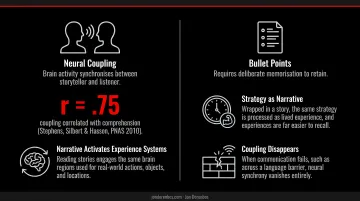
The difference isn't stylistic — it's neurological. A 2010 PNAS study by Stephens, Silbert, and Hasson found that when a speaker tells a real-life story and a listener comprehends it, their brain activity becomes temporally coupled. Crucially, the degree of that coupling correlated with comprehension (r = .75). When communication failed (across a language barrier, for instance), the coupling disappeared.
Separate research found that reading narratives activates the same brain systems used to process real-world actions, objects, and locations. Stories don't just inform. They simulate experience.
A strategy communicated as bullet points requires deliberate memorization. That same strategy wrapped in a narrative is processed as an experience, and experiences are far easier to recall.
Where Corporate Storytelling Shows Up
- Leadership keynotes and town halls
- Sales pitches and customer presentations
- Onboarding and culture programs
- Change management and reorganization communications
- Investor relations and board presentations
- Internal recognition and values reinforcement
Why Corporate Storytelling Matters for Your Business
The case for storytelling in business isn't anecdotal. Multiple research streams point in the same direction.
Stories Create Organizational Alignment
The 28% strategy recall figure isn't a communication curiosity — it's a strategy execution problem. When the people responsible for carrying out a company's direction can't articulate what that direction is, execution suffers at every level. Narrative gives strategy a human frame that makes it easier to remember, repeat, and act on.
Stories Build the Trust That Drives Engagement
Gallup's 2022 workplace research found that only 21% of employees strongly agreed they trusted organizational leadership. That number is both alarming and fixable. When leaders share authentic stories — real struggles, genuine turning points, honest admissions of uncertainty — audiences perceive them as credible rather than performing. Polished messaging signals performance. Authentic storytelling signals credibility.
That dynamic holds across industries. A qualitative study across five safety-critical Australian companies found that workers associated realistic, relatable leader stories with trustworthiness, approachability, and greater motivation to engage.
Stories Drive Change More Effectively Than Rationale
McKinsey's research on organizational transformations found that transformations were 5.8x more likely to succeed when the CEO communicated a compelling change story, and 6.3x more likely when senior leaders reinforced aligned messages. These figures reflect associations across clusters of leadership practices rather than story as a standalone cause — but the pattern holds consistently across the data.
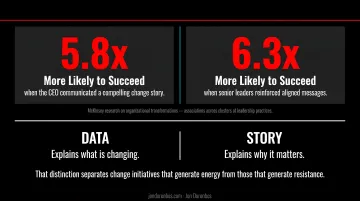
Data explains what is changing. Story explains why it matters. That distinction is what separates change initiatives that generate energy from those that generate resistance.
Stories Differentiate in Crowded Markets
Competitors can replicate products, pricing, and even talent. What they cannot replicate:
- The origin story that explains why the company was built
- The values that were tested and proven under real pressure
- The human experiences that shaped the culture from the inside
That authenticity is a competitive asset — and storytelling is how you deploy it.
The Essential Elements of a Compelling Company Story
No universal five-part formula exists for corporate storytelling — the research doesn't support one. What the evidence does support is a set of practical elements that consistently appear in stories that work.
A Relatable Character
Every powerful corporate story needs a human anchor. This could be the founder, a customer, a frontline employee, or the audience itself positioned as the protagonist. The more specific and human the character — a name, a role, a concrete situation — the more the audience connects. Generic characters produce generic responses.
An Honest Conflict
Sanitized success stories feel false. Effective corporate narratives create tension by honestly portraying obstacles, failures, or moments of genuine uncertainty. The struggle earns the audience's emotional investment. Skip the difficulty in between, and you skip the part that builds trust.
Authentic Emotion
Emotion is what converts information into memory. Whether it's resilience under pressure, pride in a team's achievement, or the vulnerability of admitting a misstep — the feeling has to be real. Audiences detect manufactured emotion immediately. There's no shortcut here: manufactured emotion reads as exactly that.
A Resolution Tied to Business Purpose
Corporate stories must earn their place in a business setting. That means every narrative needs a clear "moral" — a takeaway that connects the story to a specific value, behavior, or desired outcome. Without this, even a moving story becomes decoration rather than communication.
Concrete, Specific Detail
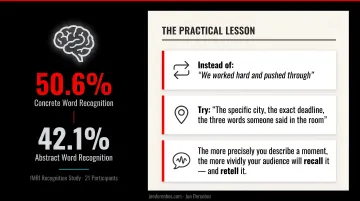
Concrete language outperforms abstract language in memory studies. In one fMRI recognition study of 21 participants, concrete words achieved 50.6% corrected recognition versus 42.1% for abstract words.
The practical lesson: swap out vague summaries for grounded specifics. For example:
- Instead of: "We worked hard and pushed through"
- Try: The specific city, the exact deadline, the three words someone said in the room
The more precisely you describe a moment, the more vividly your audience will recall it — and retell it.
Types of Corporate Stories Every Business Should Tell
The Origin Story
Every company has a founding narrative that answers: Why do we exist? When told compellingly, it creates a sense of shared purpose that motivates employees and differentiates the brand externally.
Howard Schultz's 1983 trip to Milan is the textbook example. Visiting Italian espresso bars, he saw people gathering daily — coffee as community rather than commodity. That experience became the animating story behind Starbucks's "third place" positioning, and Starbucks returned explicitly to that narrative when it opened its Milan Reserve Roastery in 2018. The story wasn't just history. It was an ongoing rationale for why the company makes the choices it does.
The Change Story
Leaders navigating transformation, reorganization, or strategic shifts need a narrative that explains not just what is changing but why it matters — and what becomes possible on the other side. McKinsey's research distinguishes between explaining the destination and making employees feel the journey's stakes.
A well-constructed change story follows a simple structure:
- Honest acknowledgment of where you are today
- The obstacle or pressure forcing a decision
- The specific choice being made in response
- What becomes possible on the other side
That arc creates urgency without manufacturing panic.
The Values-in-Action Story
Abstract values — integrity, accountability, customer focus, and others like them — mean nothing until they're embodied by a specific person making a specific choice in a specific moment. A story of an employee who made a difficult call that honored a company value does more for culture than any values poster ever printed.
These stories deserve active curation. Collect them, share them, and repeat them:
- Team meetings and all-hands sessions
- Onboarding programs for new hires
- Leadership communications and internal newsletters
How to Craft and Deliver Your Company Story
Start With Your Audience
Before crafting any story, understand who will hear it. What are their concerns? What obstacles might they have to accepting the message? A story addressed to "whoever it may concern" connects with no one. The same story told for a specific audience — their stakes, their vocabulary, their current reality — lands completely differently.
Use the "What Is / What Could Be" Structure
Nancy Duarte's Presentation Sparkline offers the most practical structure for corporate stories: establish shared reality (what is), introduce a compelling vision (what could be), alternate between the two to create tension, and conclude with the new state once the idea is embraced. This structure generates emotional momentum — it moves audiences from acceptance of the present to investment in the future.
Anchor With Personal Narrative
The most resonant corporate storytellers draw on their own lived experience. Specific moments, turning points, even failures make abstract business messages credible and human. Jon Dorenbos — whose keynote presentations for Fortune 500 audiences integrate his personal story of childhood tragedy, an NFL career, and life-saving heart surgery — demonstrates how personal narrative becomes a vehicle for organizational inspiration.
Magic serves as his engagement tool; the story is the actual delivery mechanism. The result, across 1,000+ corporate event appearances, is audiences that leave not just entertained but genuinely moved to act.
Practice Out Loud
Storytelling is a performance skill, not just a writing skill. The words on the page are a script, but delivery — pacing, pause, eye contact, emotional presence — is what makes the story land. Effective storytellers rehearse until the structure feels natural, then speak without notes.
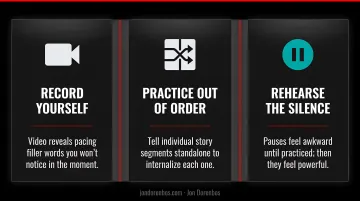
Three rehearsal habits that separate good from great:
- Record yourself — video reveals pacing and filler words you won't notice in the moment
- Practice out of order — tell individual story segments standalone to internalize each one
- Rehearse the silence — pauses feel awkward until they're practiced; then they feel powerful
Build a Story Infrastructure
Great corporate storytelling doesn't happen by accident. Organizations that do it well build systems:
- A story bank — a curated library of the company's best narratives, tagged by audience, purpose, and business context
- Story-sharing rituals — regular moments in team meetings where compelling examples are surfaced and discussed
- A storytelling collective — a small group responsible for finding and preserving the organization's best stories throughout the year
Harvard Business Publishing recommends capturing mission-in-action examples and future-vision stories, then reusing them across internal communications, leadership presentations, and culture-building efforts. When storytelling is embedded in how an organization operates — not just deployed for big moments — the narrative compounds over time.
Frequently Asked Questions
What are the 5 C's of business storytelling?
Different frameworks use different versions — one offers Circumstance, Curiosity, Characters, Conversations, and Conflict; another uses Context, Catalyst, Complication, Change, and Consequence. Neither is a universal standard. Both are memory devices pointing to the same underlying elements: context, tension, character, and resolution.
What does a corporate storyteller do?
A corporate storyteller crafts narratives that communicate a company's values, strategy, or vision in ways that create emotional connection with employees, customers, or stakeholders. They may work internally as a communications or leadership professional, or externally as a keynote speaker who helps organizations identify and tell their most resonant stories.
What is an example of corporate storytelling in action?
In his 2005 Stanford commencement address, Steve Jobs described building Apple from a garage at age 20 into a $2 billion company — then losing it — and starting over. The story wasn't a history lesson. It was a direct argument for loving what you do, told through lived experience rather than corporate messaging.
How is corporate storytelling different from regular marketing?
Marketing uses storytelling to attract customers and promote products. Corporate storytelling has a broader scope — it also covers internal communication, leadership messaging, change management, and culture building. Its primary purpose is to create meaning and alignment, not drive transactions.
How do I get started with corporate storytelling at my company?
Identify two or three authentic stories from your company's history — the founding moment, a meaningful customer impact, or a challenge your team overcame. Practice telling them conversationally before incorporating them into your next team meeting or town hall. Build the habit incrementally rather than waiting for a larger stage.