
Introduction
Sales organizations spend an average of $2,000–$5,000 per rep on a single event meant to set the tone for the year ahead. Flights booked, hotel blocks reserved, agenda slides drafted — and by Q2, the energy has evaporated.
That's the problem most SKO guides don't address directly. This one will.
What your reps believe when they walk out of an SKO determines whether it was worth the investment. Belief in the company's direction, their own potential, and the meaning behind the work — that's what drives performance through December. Without it, the event is just a calendar item.
This guide breaks down what an SKO actually is, what it needs to accomplish, how to build one that sticks, and the mistakes that make most of them forgettable.
Key Takeaways
- An SKO is an annual strategic alignment event that resets direction, culture, and priorities for the entire sales organization
- Pipeline growth is the top revenue objective, cited by 74% of B2B companies in SalesHood's survey
- Interactive formats (demos, simulations, roundtables) consistently outrank lectures in attendee preference
- Post-event reinforcement is just as critical as the event itself; build that plan before the SKO starts
- The right keynote speaker can shift a room's mindset in ways that last well past Q1
What Is a Sales Kickoff (SKO)?
Salesforce defines an SKO as an event where a company's sales team gathers — typically at the start of the fiscal year — to celebrate prior wins, set goals for the period ahead, and share lessons and strategies. A well-executed SKO is cross-functional by design. Participants typically include sales, marketing, enablement, product, and customer success. The event isn't just for sales — it's about the entire go-to-market motion, which means every function that touches revenue has a stake in how it goes.
SKO vs. Standard Sales Meeting
The difference is scope and intent. A weekly sales meeting is operational. An SKO is transformational by design.
| Standard Sales Meeting | Sales Kickoff (SKO) | |
|---|---|---|
| Frequency | Weekly or monthly | Annual (sometimes quarterly) |
| Audience | Sales team only | Cross-functional |
| Purpose | Tactical updates | Strategic alignment + mindset reset |
| Duration | 30–90 minutes | 1–3 days |
You'll also hear SKOs called annual sales meetings, sales conferences, or sales kick off events. The label varies; the mission doesn't: unite the team around a shared direction before the season starts.
Think of it like pre-season training camp in professional sports. Every player, coach, and support staff aligns their goals before the first game. The SKO serves the same function — it's the moment where individual contributors and leadership line up behind a common strategy before the first call of the new year.
Duration and Format
Most SKOs run one to two days. Larger organizations sometimes extend to three. Salesforce's own SKO reportedly runs a full week, while some companies run tightly focused two-hour sessions. Neither is universally right — the right length depends on team size, training volume, and what you're actually trying to accomplish.
In-person, virtual, and hybrid formats each carry real trade-offs worth weighing. Regardless of format, the planning discipline required is the same. Travel, venue, production, speakers, awards, and staff time add up fast — intentional design isn't optional, it's a financial imperative.
Key Goals of a Sales Kickoff Meeting
Before the first agenda item is written, the leadership team needs to agree on what success looks like. According to SalesHood's survey of more than 100 B2B SaaS and software companies, the most common revenue-focused SKO objectives break down like this:
| SKO Revenue Objective | % of Companies Reporting It |
|---|---|
| Grow pipeline | 74% |
| Improve win rates | 60% |
| Improve pipeline progression | 58% |
| Increase upsell/cross-sell | 48% |
| Improve quota attainment | 46% |
| Accelerate rep ramp | 42% |
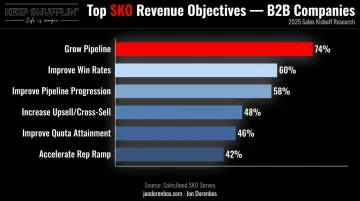
Pipeline growth leads — but notice that the list spans both skill development (win rates, pipeline progression) and motivation (quota attainment, rep ramp). That combination reflects what an SKO is actually built to do: sharpen skills and reset motivation at the same time.
Beyond Information Transfer
The motivational dimension of an SKO is where most events fall short. A slide deck can transfer information, but it takes a shared experience to shift how a team thinks and performs.
Teams that leave with both clarity and energy — a genuine sense that leadership has a real plan and that this year is different — consistently outperform teams that leave with only a new deck and a refreshed quota number.
Define your success metrics before planning begins. What should reps know, and how should their behavior change as a result? Post-event survey scores, Q1 pipeline activity, and knowledge retention quiz results are all measurable. Set the targets early, or you won't know if you hit them.
What to Include in Your SKO: Core Elements
Keynote and Inspirational Moments
The opening tone of an SKO sets the psychological frame for everything that follows. A powerful keynote can shift a room from routine check-in mode to genuine conviction — and that shift is worth more than any slide deck.
What separates effective SKO keynotes from forgettable ones: the speaker doesn't just inform. They connect. They draw on real adversity, real reinvention, and real stakes to make the audience feel something that translates into performance.
Jon Dorenbos — former NFL player, America's Got Talent finalist, and keynote speaker with appearances for companies including Apple, Marriott, and RE/MAX — is a strong example of this approach. His keynote pillars map directly onto what sales teams need heading into a new year:
- Self-talk and mindset: How the internal dialogue after a lost deal shapes the next call
- Resilience through adversity: Bouncing back from bad quarters without carrying the weight forward
- Embracing change: Adapting to new territories, products, or quota structures
- Teamwork and accountability: What trust within a team actually produces in performance
Nick Bailey, President and CEO of RE/MAX, described Jon as giving "the first time I witnessed a speaker get an unsolicited standing ovation 1/2 through their presentation." For an SKO audience, that kind of response isn't entertainment — it's alignment.
His book Life Is Magic is also available in bulk for event distribution, giving organizers a leave-behind that extends the keynote's impact well past day one.
Training and Skill-Building Sessions
SKO training content typically falls into three buckets:
- Product and market knowledge — new launches, competitive positioning, updated value propositions
- Sales skills — negotiation, objection handling, discovery techniques
- Process and tools — CRM updates, playbook changes, technology walkthroughs
According to Opus Agency's attendee research, here's how sales professionals actually want to learn at their SKO:
| Format | Attendees Preferring It |
|---|---|
| Hands-on demonstrations | 61% |
| Simulations and practice sessions | 60% |
| Roundtables and panels | 55% |
| Keynotes or lecture-style sessions | 35% |
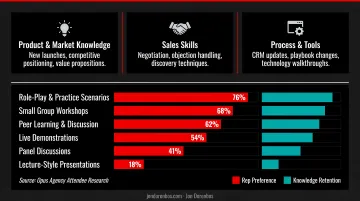
The gap between interactive formats and lecture-style delivery is striking. Reps prefer doing over watching — and what they prefer tends to stick better.
Recognition and Celebration
Once reps have built new skills, recognition channels that energy into motivation. Recognition at an SKO isn't a feel-good add-on — it reinforces the exact behaviors and results you want replicated. Public awards create healthy competition, validate effort, and signal to the broader team what "great" looks like.
Avoid limiting awards to revenue-only categories. Consider recognizing:
- Most improved year-over-year
- Best rookie performance
- Strongest team collaboration
- Most creative deal won
Broader recognition motivates a broader portion of the team — which matters if you want the bottom half of your distribution to move, not just the top 10%.
Team-Building and Networking
For hybrid or remote teams, the SKO may be the only time the full group is physically in the same room. Structured activities build the trust that makes collaborative selling possible.
A rep who's met their inside sales counterpart in person handles handoffs differently than one who's only seen a Slack username.
Formats that work well for SKO team-building include:
- Breakout groups mixing regions or business units
- Competitive challenges tied to sales scenarios
- Informal social dinners or activities on the evening before the main program
- Peer recognition exercises that surface unrecognized contributions
How to Plan a Sales Kickoff: Step-by-Step
Step 1: Define Objectives Before You Plan Anything
Start with purpose, not logistics. What do you want reps to know, feel, and do differently after the SKO? Every agenda item should trace back to a measurable objective. If a session can't answer that question, it shouldn't be on the agenda.
Step 2: Build a Cross-Functional Planning Team
The best SKOs are built with input from marketing, product, customer success, and HR — not just sales leadership. Each function brings content and perspective that rounds out the experience and prevents the event from feeling like a sales-only silo.
Step 3: Design a Balanced Agenda
The most common agenda mistake: front-loading all presentations. Mix formats throughout:
- Inspirational keynotes
- Interactive skill-building workshops
- Q&A panels with leadership
- Peer-led sessions
- Social and networking activities
Keep individual sessions concise. Attention spans are finite. A tight 45-minute session with interaction beats a 90-minute lecture every time.
Step 4: Assign Pre-Work
Distribute short videos, product primers, and role-specific reading before the event. When reps arrive already oriented, the SKO itself can shift from information delivery to active practice and real discussion. Every hour on-site gets used at a higher level.
Step 5: Plan Post-Event Reinforcement Before the SKO Happens
Pre-work sets reps up to engage. What happens after the event determines whether that engagement sticks. Build the reinforcement plan before day one — not as an afterthought once everyone returns to their territories:
- Resource hubs for key content
- Follow-up quizzes tied to training objectives
- Coaching schedules tied to skills introduced at the SKO
- Communication that keeps the theme alive through Q1
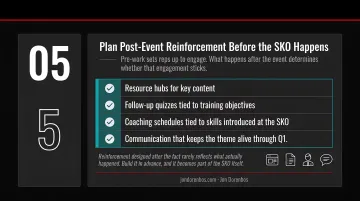
Reinforcement designed after the fact rarely reflects what actually happened. Build it in advance, and it becomes part of the SKO itself.
Common Sales Kickoff Mistakes to Avoid
Most SKOs underperform not because of bad intentions, but because of predictable, avoidable errors. Here are the most damaging ones:
- Overloading the agenda: covering too much ensures nothing actually lands
- Running one-way presentations back-to-back: if reps aren't doing anything, they aren't retaining anything
- Failing to communicate goals in advance: reps who don't know why they're there can't engage with intention
- Skipping post-event follow-up: without reinforcement, the SKO fades within weeks
The relevance gap is particularly destructive. When sessions feel disconnected from reps' day-to-day reality — abstract strategy talks, product demos that don't connect to actual sales conversations — engagement collapses. Every session should implicitly answer: how does this help me close more deals?
The most underestimated mistake is treating the SKO as a self-contained event. Without coaching checkpoints, reinforcement sessions, and accountability structures in the weeks that follow, the momentum built at the SKO dissipates before Q1 is over.
How to Measure SKO Success and Keep Momentum Going
Immediate Feedback
Collect post-event surveys and session-level ratings while the experience is still fresh. This captures what resonated, what felt irrelevant, and what needs rethinking for next year. Rep self-assessments taken within 24–48 hours of the event are particularly useful for identifying confidence gaps.
Longer-Term KPIs
Survey scores tell you what reps felt. Pipeline tells you what actually changed. According to SalesHood's research, 28% of sales leaders were unsure how to measure SKO impact — a gap that starts with not defining metrics before the event. Track:
- Knowledge retention quiz scores (2–4 weeks post-event)
- Q1 pipeline creation and activity levels
- Sales cycle velocity compared to prior year
- Rep engagement with post-event resources
Define these metrics during SKO planning — not after — so results can be benchmarked against clear goals from day one.
The Manager's Role
Managers are the bridge between the SKO and sustained behavior change. Without active involvement, even a well-executed event loses its impact within six weeks. Reinforce momentum by:
- Running weekly coaching check-ins tied to skills introduced at the event
- Reinforcing specific behaviors with direct feedback (not just general praise)
- Recognizing reps who apply what they learned — publicly, where possible
That visible follow-through is what carries SKO energy past Q1 and into the rest of the year.
Frequently Asked Questions
What does sales kickoff mean?
A sales kickoff (SKO) is an annual internal event where the full sales organization gathers to align on goals, train on new skills and products, celebrate past wins, and build motivation for the year ahead. It's typically held at the start of a fiscal year or major selling quarter.
What is the 30-60-90 rule in sales?
The 30-60-90 day plan is a ramp-up framework for new or re-aligned reps. The first 30 days cover learning and orientation; the next 30 focus on building pipeline; the final 30 target early deal closures. Many organizations structure their SKO agenda to align with this cycle.
How long should a sales kickoff meeting last?
Most SKOs run one to two days, with larger organizations sometimes extending to three. The right length depends on team size, training volume, and budget — a tightly structured one-day event often outperforms a bloated three-day agenda.
What should a sales kickoff agenda include?
A strong SKO agenda covers:
- Motivational keynote to open with energy and direction
- Strategy and goal-setting presentations
- Product and skills training sessions
- Team-building activities and structured networking
- Recognition and awards for top performers
What separates a great agenda from a forgettable one is how well these elements are balanced, not just whether they're included.
How do you measure the success of a sales kickoff?
Measure immediately through post-event survey scores and session ratings, and longer-term through knowledge retention quizzes, Q1 pipeline activity, and rep engagement with post-event resources. Define all metrics before the event, not after.
What is the difference between a sales kickoff and a sales conference?
A sales kickoff is an internal event focused on aligning and motivating the sales team for the year ahead. A sales conference is typically industry-wide or customer-facing. The SKO is inward-facing and strategic; the conference is generally outward-facing and educational.