Yet many first-time speakers and event organizers freeze when it's time to actually write one. How long should it be? What's the right structure? How do you avoid sounding like every other conference speech attendees have already forgotten?
This guide breaks down what a keynote address actually is, how it differs from a standard presentation, and a practical framework for writing and delivering one that earns a standing ovation instead of polite applause.
Key Takeaways
- A keynote address sets the central theme for an entire event, unlike session-specific presentations
- Successful keynotes rely on one clear throughline, not a laundry list of ideas
- Narrative-driven speeches are measurably more memorable than fact-heavy ones
- Rehearsal time, not just writing time, determines delivery quality
- Speaker fit matters more than fame when booking outside talent
What Is a Keynote Address?
The word "keynote" comes from music — the key note is the tone that establishes the scale everything else in a piece is built around. A keynote address does the same job for an event: it sets the pitch that every other session, panel, and breakout follows.
Merriam-Webster traces the term's use for speeches back to 1863, defining it as an address that presents the issues of primary interest to an assembly, often designed to build unity and enthusiasm. In practice, that means a keynote exists to:
- Unify the audience around one shared idea before the day's programming splits into smaller tracks
- Energize the room so attendees walk into breakout sessions already engaged
- Frame the event's goals, giving everyone a lens for the sessions that follow
Where Keynotes Show Up
You'll find keynote addresses opening or closing:
- Corporate conferences and industry trade shows
- Political conventions
- Sales kickoffs (SKOs)
- Graduation and commencement ceremonies
- National association meetings
How Long Should One Run?
Conference programming commonly allocates 45 to 60 minutes for a keynote slot, often split between the speech itself and a short Q&A. That window is long enough to build a full narrative arc without losing the room, which is why it stuck as the industry standard.
Who Actually Delivers Them
Keynotes usually go to someone whose expertise or story elevates the event beyond an internal presentation. That often means a subject-matter expert, a notable executive, or a public figure with a compelling personal narrative.
Brands increasingly book speakers who blend performance with story. Jon Dorenbos, a former Philadelphia Eagles long snapper turned America's Got Talent finalist, is a clear example. His keynotes weave a 14-year NFL career, a life-threatening heart condition found days after a trade to the Saints, and sleight-of-hand magic into one narrative arc. That mix has landed him over 1,000 appearances for companies like Apple, Marriott, and Kroger.

Keynote Address vs. Keynote Speaker vs. Presentation
These three terms get used interchangeably, but they mean different things — and mixing them up leads to misaligned expectations between organizers and speakers.
| Term | What It Actually Means |
|---|---|
| Keynote address | The speech itself: the content, structure, and message |
| Keynote speaker | The person delivering that speech |
| Presentation | A narrower, session-specific talk, often data-driven |
The address is the message; the speaker is the messenger. You book a keynote speaker to deliver a keynote address—two labels for different halves of the same moment on stage.
A presentation, by contrast, is scoped to a single breakout room. It's typically shorter, more data-heavy, and doesn't carry the responsibility of setting the tone for an entire event. Presentations answer a specific question for a specific group; keynotes give everyone in the building a shared starting point.
Getting this distinction right matters for event planners. If you brief a speaker for a "presentation" when you actually need a theme-setting keynote, you'll end up with a talk that's too narrow for the room's expectations, and an audience that walks out without a unifying takeaway.
What Makes a Keynote Address Successful?
Not every keynote lands. The ones that do share a few specific traits, and none of them are about having the flashiest slides.
A clear throughline. Every successful keynote ties back to one core, repeatable idea. If an attendee can't summarize your message in a single sentence walking out the door, the speech tried to do too much.
Audience-specific research. Generic stories fall flat. Speakers who reference the audience's actual industry, challenges, or recent company milestones build instant credibility: the difference between "I've spoken to executives before" and "I know what your team is dealing with right now."
Authenticity over polish. This is where storytelling earns its keep. A 2021 meta-analysis covering more than 33,000 participants found narrative content produces significantly better memory and comprehension than straight expository information. Researchers measured the memory advantage at a Hedges' g of .72, a large effect size.
That's the science behind why a well-told personal story outperforms a slide full of bullet points. Jon Dorenbos builds keynotes the same way: childhood tragedy and an NFL career form the emotional spine, then live magic makes each turning point physically visible rather than just spoken.
One documented example: at a corporate conference, he used a card illusion to illustrate the event's own slogan, "Get on the same page," and earned a standing ovation mid-presentation, before the speech had even ended.
How to Write a Keynote Address
Strong keynotes don't get written the week before. Begin weeks or months out with one thing: a single distilled message the audience should be able to repeat afterward. Build everything else in the speech around that sentence.
Structure the Speech for Maximum Impact
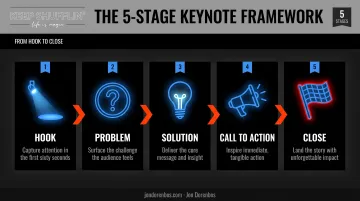
A reliable five-part framework keeps a keynote from wandering:
- Hook — an opener that grabs attention in the first two minutes
- Problem — the pain point or tension the audience already feels
- Solution/Core Message — the central idea the whole speech supports
- Call to Action — what you want the audience to do or think differently
- Close — a memorable final beat that reinforces the message
This sequence echoes Monroe's Motivated Sequence, a persuasive speech structure that's been taught since 1935: attention, need, satisfaction, visualization, action.
Within that structure, lean on the Rule of Three. Grouping ideas into threes — three points, three stories, three takeaways — makes them easier to track and recall than a longer, looser list. That grouping keeps a speech from feeling like a checklist and helps the room remember what matters.
Craft a Strong Opening and Closing
Your opening two minutes decide whether the room leans in or checks their phone. Three openers consistently work:
- A surprising fact or statistic that reframes how the audience thinks about the topic
- A personal or relatable story that puts a human face on the theme
- A bold question that forces the audience to silently answer for themselves
Closings matter just as much. The strongest options:
- Summarize the core message in one clean, quotable line
- Deliver a specific call to action — not "think differently," but a concrete next step
- Return to the opening story for a full-circle effect that ties the whole speech together
That full-circle technique is why a line like "Life happens. Good, bad, and ugly. What separates people is how they handle it" lands so hard. It only carries weight because the audience has already watched that philosophy play out in the speaker's story.
How to Deliver a Keynote Address with Impact
Writing the speech is half the job. Delivery is where most first-time keynote speakers lose the room, not because the content is weak, but because the rehearsal was thin.
Spend more time rehearsing than writing. Run the full speech standing up, out loud, with slides or props in hand, multiple times. Reading it silently at your desk doesn't count: your mouth needs to physically practice the transitions your brain has already planned.
Master Body Language, Voice, and Pacing
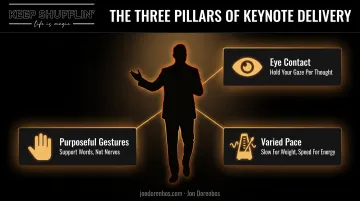
Delivery mechanics separate a memorized speech from a lived one:
- Eye contact: Hold on one listener for the length of a full thought, then shift at a natural pause
- Purposeful gestures: Movement should support the words, not fill nervous energy
- Varied pace: Slow down for weight, speed up for energy, and use silence deliberately before key lines
Non-verbal tools do a lot of the emotional heavy lifting. Tone, cadence, and interactive elements (a demonstration, a prop, a piece of live magic) keep an audience engaged on a level words alone can't reach. That's why a speaker like Jon Dorenbos performs card tricks as metaphors mid-story rather than as a separate entertainment segment; the illusion is the point, not a break from it.
Manage Stage Fright and Build Real Connection
Nerves before walking on stage are close to universal. Public speaking anxiety is common, not a sign something's wrong with you.
Two techniques help in the moment:
- Deep breathing before you walk on, to physically lower heart rate
- Reframing nerves as energy instead of trying to force calm
Research from Harvard Business School found that speakers who told themselves "I am excited" rather than "I am calm" were rated more persuasive, confident, and competent. They also spoke longer than those who tried to suppress the nerves entirely.
Audiences aren't waiting for you to fail. They want you to succeed. Genuine connection beats flawless delivery every time. A stumbled line rarely costs you the room; a disconnected, over-rehearsed one will.
Choosing the Right Keynote Speaker for Your Event
Not every event needs an outside speaker. An internal executive can open a quarterly all-hands just fine. But for major conferences, sales kickoffs, or milestone events that need a fresh, high-energy voice the room hasn't heard a dozen times already, a professional speaker can raise energy and focus in ways a familiar internal voice often can't.
What to Look For
When vetting outside speakers, prioritize:
- A compelling personal story that connects to the event's theme, not just a resume
- Proven stage experience across varied audiences and formats
- Willingness to customize messaging around your organization's specific goals
- A track record with recognizable organizations in your industry or a comparable one
Fit matters more than fame. In a 2024 survey of 340 event organizers, audience engagement ranked as the top booking priority at 67%, ahead of name recognition or celebrity status.
Jon Dorenbos illustrates what that fit looks like in practice. His narrative draws on a 14-year NFL career with the Philadelphia Eagles, a run as an America's Got Talent finalist, and surviving emergency heart surgery days after a trade—a personal arc most speakers can't match.
The real differentiator is customization. He works with event teams to build keynotes around specific themes: resilience, teamwork, change management, self-talk, and accountability, rather than delivering one fixed talk to every room.
His client list spans Fortune 500 companies including Apple, Marriott, and Kroger, with over 1,000 event appearances and a track record of standing ovations. One unsolicited ovation landed halfway through a RE/MAX keynote. For organizations weighing a celebrity-tier speaker, that kind of repeatable audience impact is the evidence to trust—not just the name on the marquee.

Event teams can reach out directly to discuss availability and customization for a specific event.
Frequently Asked Questions
What is the purpose of a keynote address?
A keynote address sets the tone for an event, unifies the audience around a central theme, and inspires action or reflection tied to the event's broader goals. It gives every other session a shared starting point.
What is the difference between a keynote speaker and a keynote address?
The keynote address is the speech itself — the content and message. The keynote speaker is the person who delivers it. One is the message, the other is the messenger.
What is the difference between a keynote and a presentation?
Keynotes set the event-wide theme and typically open or close a program. Presentations are narrower, session-specific, and often more data-focused, without the responsibility of framing the entire event.
How long should a keynote address be?
Most keynotes run between 30 and 60 minutes, with 45 minutes as a common convention that balances a full narrative arc against audience attention.
Who typically delivers a keynote address at corporate events?
Usually a recognized expert, senior executive, or public figure chosen specifically to energize the room and align attendees around the event's purpose.
How do I start writing my own keynote address?
Start with a single core message you want the audience to repeat afterward. Then build the speech around a hook, the problem it solves, your core message, a call to action, and a memorable close.