
Introduction
Sales is a grind. Targets shift, pipelines stall, and rejection shows up before lunch on a Tuesday. No quota board or commission structure fully prepares a rep for the psychological weight of a cold streak — and a single pep talk rarely survives contact with Monday morning.
That's why the most durable motivation doesn't come from a strategy or a script. It comes from a story. When salespeople hear real accounts of people who refused to quit — who rewrote their narrative after catastrophic failure — something shifts. The loss they're carrying feels less like a verdict and more like a chapter.
According to Salesforce's 2022 research, 25% of sales teams experience average annual turnover, with nearly one in four reps planning to seek another job within 12 months. Turnover at that scale signals a structural issue — but stories can hold teams together through hard stretches while leaders work on the deeper fixes.
This post shares six motivational stories for sales teams drawn from athletes, entrepreneurs, and icons. Each comes with a clear lesson and a leadership takeaway you can use tomorrow.
Key Takeaways:
- Rejection is a data point, not a verdict — every story here demonstrates that.
- How a rep talks to themselves after a loss shapes performance more than the loss does.
- Adaptability, not just persistence, separates top performers from those who stall.
- Great sales cultures celebrate support and shared wins, not just individual competition.
- Live, shared experiences — not just articles — create the kind of motivation that sticks.
Why Sales Teams Need Motivational Stories
Stories work differently than motivational quotes. A quote gives you a phrase. A story gives you a path — and a specific human being who faced a real wall and found a way through it. That specificity creates empathy, and empathy makes lessons stick.
Research supports this. Two findings are worth knowing:
- A 2024 experiment found measurable gains in recall, engagement, and immersion when information was delivered through narrative rather than bare facts.
- A meta-analysis across 23 studies and 1,511 teams found that shared mental models correlated with team performance at rho = .29 — meaning a common reference point and shared language actually moves the needle on results.
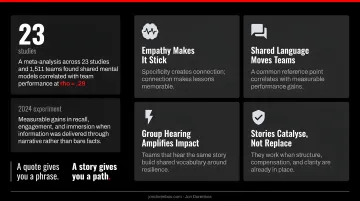
Stories are especially powerful in group settings. When an entire sales team hears the same story together — at a kickoff, a team meeting, a leadership event — they build a shared vocabulary around values like resilience and persistence. "This is our Schultz moment" means something specific. "Don't stop at 217" becomes shorthand for pushing through a pipeline that feels impossible.
That said, stories aren't a substitute for good management, fair compensation, or clear goals. They work best as a catalyst — something that sharpens focus and shifts mindset when your team already has the structure to act on it. The six stories below are built for exactly that moment.
6 Motivational Stories for Sales Team Inspiration
Story 1: Jon Dorenbos — From Unimaginable Tragedy to NFL Legend and Beyond
At age 12, Jon Dorenbos watched his life shatter. His father murdered his mother, and Jon spent the next year moving through foster care before eventually relocating to Southern California with relatives. Most people would define their life by that moment. Jon decided to define his response instead.
He channeled his pain into football and magic — building a 14-year NFL career as a long snapper, reaching the finalist stage on America's Got Talent, and surviving open-heart surgery in 2017 after a routine exam discovered a life-threatening aortic aneurysm just days before a trade to the New Orleans Saints.
Today, he's one of the most sought-after keynote speakers for Fortune 500 companies, with over 1,000 event appearances for clients including Apple, Marriott, and RE/MAX.
His core message is direct: "Life happens. Good, bad, and ugly. What separates people is how they handle it."
Sales lesson: Jon's story is about authorship. He didn't choose the hand he was dealt — but he wrote his own response to it. For salespeople, this reframes rejection entirely. A lost deal isn't proof that you can't win; it's a chapter, not a conclusion. The question is what story you tell yourself next.
Leadership takeaway: The internal conversations your team has about failure shape performance more than quota numbers do. Jon's keynote explicitly covers self-talk as a core theme — the idea that "the words we tell ourselves determine the life we live." Leaders who help reps build a resilient inner narrative create teams that show up consistently, even through brutal stretches.
Story 2: Joe Girard — The World's Greatest Salesman
Joe Girard grew up poor, worked a string of failed jobs, and eventually walked into a Chevrolet dealership looking for work. What happened next is documented in the Guinness World Records.
Over a 13-year career from 1963 to 1977, Girard sold more than 13,000 cars — averaging six per business day, with 1,425 in his best year and 18 in his single best day. Guinness named him "The World's Greatest Retail Salesman" for 12 consecutive years.
His edge wasn't price or location. It was relationships. Girard was relentless about follow-up and personal appreciation — staying in front of every customer long after the keys changed hands. He understood that the sale was the beginning of the relationship, not the end of it.
Sales lesson: Consistency and care are a competitive advantage that compounds. Girard's record wasn't built on a handful of legendary closes. It was built one follow-up, one personal touch, one returning customer at a time. Volume and relationship quality together — not either alone — created his results.
Leadership takeaway: Coach your team to think past the close. Referrals, renewals, and reputation are built in the post-sale relationship, and those returns accumulate over months and years. Define a sustainable follow-up cadence and make it a team standard, not a personal quirk.
Story 3: Howard Schultz — 217 Rejections Before Starbucks Changed Coffee Culture
In 1983, Howard Schultz traveled to Milan and fell in love with the ritual of Italian espresso culture. He came back convinced that Americans would pay for that experience. Almost nobody believed him.
As Schultz has recounted in interviews, he approached 242 people to fund his vision — and 217 of them said no. He wasn't rejected by 242 investors; he was rejected by 217 out of 242 he approached. The distinction matters: he kept refining his pitch, kept finding new rooms to walk into, and eventually found enough believers to create Il Giornale, the café concept that eventually became Starbucks.
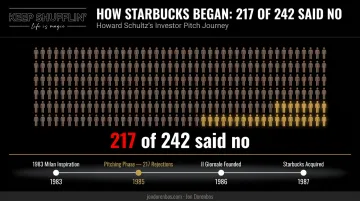
Sales lesson: Volume of rejection isn't a signal to stop — it's part of finding the right fit. Schultz didn't change his vision after the first hundred no's. He got better at communicating it. The prospect who says yes exists; the question is whether you stay in the process long enough to reach them.
Leadership takeaway: Help reps reframe "no." Often it's "not yet," "not framed right," or "not the right person in the room." Coach your team to track what they learn between rejections, not just how many they collect. Pitch refinement is a skill — treat it like one.
Story 4: Sara Blakely — Door-to-Door Grit to Billion-Dollar Brand
Before Spanx, Sara Blakely spent seven years selling fax machines door-to-door for Danka, eventually becoming a national sales trainer. Those years taught her something invaluable: how to demonstrate value in real time, in front of a skeptical buyer, with no safety net.
When she put her $5,000 in savings into Spanx, she had no fashion background and no retail connections. She cold-called the buyer at Neiman Marcus, got a meeting, and — when the verbal pitch wasn't landing — asked the buyer to follow her to the restroom, where she demonstrated the before-and-after effect on herself. She closed her first major retail deal in a department store fitting room.
Sales lesson: Customer proximity and creative demonstration beat polished presentations. Blakely won because she understood the problem better than anyone and found a way to make the buyer feel it rather than just hear about it. The best pitches aren't scripted — they're specific, personal, and rooted in genuine problem-solving.
Leadership takeaway: Encourage reps to get closer to the customer's lived experience. Consider these approaches:
- Role-play discovery conversations, not just objection handling
- Ask reps to articulate the buyer's problem in the buyer's own words before pitching
- Reward solutions that show genuine customer understanding, not just polished delivery
The closer a rep gets to what the buyer actually feels, the more relevant — and compelling — their pitch becomes.
Story 5: Ross Perot — From IBM's Top Salesman to Building a Tech Empire
In 1962, Ross Perot completed his entire annual IBM sales quota in 19 days. He wasn't rewarded with a bigger opportunity — he was largely ignored. IBM's structure had no room for what he wanted to build, so he left.
He incorporated Electronic Data Systems on June 27, 1962, and spent years convincing corporations to trust a new, unproven model for data processing services. The rejections were constant. But Perot believed in the idea more than he believed in the obstacles, and he kept executing. General Motors eventually acquired EDS for $2.5 billion in 1984.
Sales lesson: Resilience in sales isn't only about handling rejection from customers — it's also about believing in your own ideas enough to keep pushing when the environment around you isn't ready. Perot recognized an opportunity, executed at speed, and didn't wait for permission.
Leadership takeaway: Top performers sometimes need room to run. Recognizing when your best people are constrained — by process, by territory, by internal friction — and clearing the path for them is one of the highest-leverage things a sales leader can do.
Story 6: Daymond John — Building FUBU with Hustle, Community, and a $100,000 Bet
Daymond John learned to sew from his mother in their home in Hollis, Queens. He started FUBU with almost no capital, selling t-shirts out of his neighborhood while working shifts at Red Lobster to keep the lights on.
When 27 banks rejected him, his mother took out a $100,000 home-equity loan to fund expansion — a risk that still carries weight when you say it out loud.
What built FUBU before any major retailer gave it a shot was community. John understood his customers because he was his customer. He leveraged neighborhood relationships, peer visibility, and consistent action to build momentum before he had any institutional support.
On his own site, John wrote: "When I got kicked down, I always made sure to learn from the mistakes and get back up stronger than ever."
Sales lesson: Success in sales — like in entrepreneurship — is built through action, feedback, and adjustment. John didn't wait for perfect conditions. He acted, learned, and scaled. That loop built the brand. Not a single brilliant move — sustained iteration.
Leadership takeaway: Sales cultures that celebrate support — peer coaching, shared wins, team accountability — outperform cultures built entirely on individual competition. Give your reps a reason to invest in each other's success, not just their own quota.
What Every Story Teaches Us: Common Themes for Sales Success
Look across all six stories and one pattern stands out: none of these people succeeded on the first attempt, and none of them let a single setback — or hundreds of setbacks — determine their outcome.
The shared mechanism isn't optimism. It's action followed by feedback.
- Dorenbos reframed his entire identity around adversity
- Girard followed up relentlessly, long after others stopped
- Schultz repitched the same vision until the right investor heard it
- Blakely demonstrated the product because the pitch alone wasn't enough
- Perot executed with a sprint — 19 days, quota done
- John kept making calls until the skill caught up with the goal
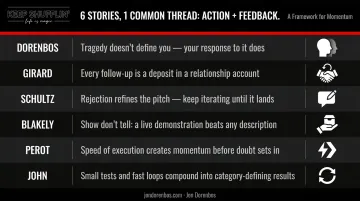
Each path looked different. Perot's quota sprint took 19 days. Schultz's investor rejection stretched across years. Don't compress these into a single "try harder" lesson — the time horizons and contexts matter.
Two other threads run through every story, and both have practical implications for sales leaders.
Identity Drives Resilience
The most resilient people in these stories weren't just chasing a number. They were driven by a belief in what they were doing. Most leaders overlook this entirely — connecting sales work to a larger "why" is one of the highest-leverage motivation tools available, and it costs nothing to use.
Adaptability Is Measurable
Several stories involve a pivot — a new demonstration, a refined pitch, a different market. A peer-reviewed meta-analysis by Franke and Park found that adaptive selling behavior correlated at rho = .27 with salesperson performance across self-rated, manager-rated, and objective measures. Adaptability isn't a soft skill — it's a performance predictor.
How to Turn Inspiration Into Sales Action
Reading a motivational story creates a temporary lift. What creates lasting change is pairing the story with a structural prompt: what specifically changes tomorrow?
Three approaches that work:
Start weekly meetings with one story. Share a short version — two to three minutes — then facilitate a five-minute discussion. What does this lesson look like applied to the challenge your team faces right now?
Ask reps for their own comeback story. A deal they nearly lost but recovered. A rejection that led to a better outcome. Shared peer stories normalize struggle and build team identity faster than external examples.
Tie the lesson to a specific behavior. Don't leave it at "be more resilient." Connect Sara Blakely's story to a concrete ask: this week, find one way to show rather than tell your prospect what the outcome looks like.
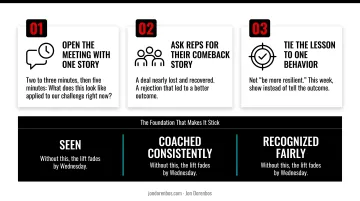
These tactics only work when the environment supports them. When team members feel seen, coached consistently, and recognized fairly, story-driven inspiration has a foundation to land on. Without that foundation, the lift fades by Wednesday.
Bring the Story to Life: Live Keynote Inspiration for Your Sales Team
Articles can deliver a message. A live keynote experience creates something different — a shared, emotionally resonant moment that an entire team experiences together and references long after the event ends.
Jon Dorenbos brings exactly that kind of moment to Fortune 500 sales teams, corporate kickoffs, and leadership events. His keynotes blend world-class magic performance with a personal story — childhood tragedy, 14 years in the NFL, a life-saving heart surgery, and an America's Got Talent finalist run — messaging that connects directly to how teams handle pressure, adapt to change, and find purpose in their work.
The results speak for themselves. RE/MAX CEO Nick Bailey called it the first time he'd ever witnessed a speaker receive an unsolicited standing ovation halfway through a presentation. Michael Clarke, Director of B2B Marketing at Marriott International — after 17+ years producing events — called Jon "by far the most powerful, engaging, dynamic and authentic presenter I have ever hired."
With 1,000+ event appearances and clients including Apple, Marriott, RE/MAX, Kroger, and Campbell Soup Company, Jon's ability to tailor his story to your team's specific challenges — and make an entire room feel it — is consistent across every stage.
If your team needs more than a blog post, Jon's booking page is where to start.
Frequently Asked Questions
How do you motivate an unmotivated sales team?
Start by understanding what's actually causing the disengagement — unclear goals, burnout, and lack of recognition each require different responses. From there, reintroduce purpose through shared stories, peer recognition, and consistent coaching rather than layering on more pressure.
What is the best motivational story for a sales team?
The best story is the one most relevant to what the team is currently facing. Stories of rejection and comeback resonate most during hard stretches, while stories of vision and persistence land well at the start of a new sales cycle or goal-setting period.
What is the 70/30 rule in sales?
The 70/30 rule, popularized by Sandler, holds that prospects should speak 70% of the time while salespeople speak 30%. Gong's research puts the actual ratio for successful calls closer to 57/43, so use it as a directional guide rather than a fixed formula.
Why is storytelling important for sales teams?
Stories make information memorable and create emotional connection. They help salespeople understand why something matters — not just what it is — and they give prospects a way to see themselves in the outcome you're describing.
How do motivational stories help sales performance?
They reframe how reps interpret setbacks, normalize the struggle that comes with sales, and give teams a shared reference point for resilience. Research on salesperson resilience links intrinsic motivation — which stories are well-positioned to activate — to stronger performance after rejection.