
Introduction
Disruption used to arrive with warning. Now it doesn't bother knocking.
Today's leaders face a compounding reality: technological shifts, economic volatility, workforce transformation, and geopolitical instability aren't arriving one at a time. They're hitting all at once.
PwC's 2023 Global Crisis and Resilience Survey of 1,812 leaders across 42 countries found that 96% had experienced significant disruption within two years, with the average organization navigating 3.5 disruptions during that period.
The central tension leaders feel is real: drive performance, hold teams together, make decisions with confidence, while the ground keeps shifting beneath every plan.
This article defines what disruptive leadership actually looks like, builds the case for resilience as a strategic competency, and offers five actionable strategies for leaders who want to do more than survive disruption — and build something stronger because of it.
Key Takeaways
- Disruption is a permanent fixture — leaders who build adaptive capacity outperform those who only react to crises
- Disruptive leadership challenges the status quo constructively, not recklessly
- Resilience is a skill leaders can develop — not a personality trait you either have or don't
- Psychological safety and transparent communication are the foundation of high-performing teams under pressure
- Purpose-driven leadership sustains engagement when process and certainty both fail
What Is Leadership in the Age of Disruption?
The phrase "age of disruption" describes something specific: a business environment defined by VUCA conditions — Volatile, Uncertain, Complex, and Ambiguous — where multiple crises converge simultaneously rather than arriving in sequence.
The data makes this concrete. PwC's 27th Annual Global CEO Survey found that 45% of 4,702 CEOs globally doubted their business would be viable within ten years without significant reinvention — up from 39% just one year prior. That's a structural shift in how often and how hard disruption lands, not a blip of executive anxiety.
Crisis Management vs. Leading Through Disruption
There's a critical difference between the two — and conflating them is where many leaders stall.
| Crisis Management | Leading Through Disruption | |
|---|---|---|
| Orientation | Reactive | Proactive and ongoing |
| Timeframe | Defined event with a clear end | No finish line — continuous adaptation |
| Goal | Extinguish the fire, restore the plan | Build capacity to operate without a plan |
| Risk of misuse | Works for isolated incidents | Fails when applied to structural change |
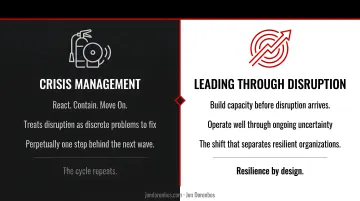
Leaders who treat every disruption as a discrete problem — something to fix and move past — are perpetually behind. The shift that separates struggling organizations from resilient ones isn't faster recovery. It's building the capacity to operate well before the next disruption arrives.
What Disruptive Leadership Actually Means
Disruptive leadership is a behavioral pattern, not a personality type. It actively challenges the status quo, drives constructive change, and cultivates innovation rather than defaulting to comfort.
This stands in direct contrast to traditional command-and-control leadership. That model works when the environment is predictable. Under fast-moving VUCA conditions, it becomes a liability: too slow, too rigid, too dependent on one person having all the answers.
Constructive vs. Destructive Disruption
Not all disruption creates value. The difference comes down to intent and outcome. Destructive disruption is change for change's sake — driven by ego or restlessness — that erodes trust without purpose. Constructive disruption is purposeful innovation that creates real value for employees, customers, and the organization.
Microsoft under Satya Nadella is one of the clearest documented examples. When Nadella took over in 2014, he replaced the company's "know-it-all" culture with a growth mindset — prioritizing learning, experimentation, and intellectual humility. Revenue grew from $86.8 billion in FY2014 to $245.1 billion in FY2024. Culture alone didn't cause that — strategy, cloud execution, and market conditions all played a role — but the cultural reset made sustained reinvention possible.
The Behaviors That Define It
Disruptive leaders are recognizable by what they do, not what they're called:
- Asking "How can we make this better?" rather than "Why change what works?"
- Welcoming dissenting perspectives instead of filtering for agreement
- Making bold decisions in ambiguity with both speed and deliberateness
- Treating resistance as data, not defiance
That last point matters. The most common friction disruptive leaders face comes from employees, senior teams, and stakeholders who fear change. The prerequisite to any disruptive initiative isn't a better strategy deck — it's trust, built through consistent and transparent communication of vision and rationale.
When a leader earns that trust and models this approach authentically, teams start problem-solving more creatively, taking calculated risks, and building the collective adaptability the whole organization needs.
The Resilience Mindset: The Foundation of Thriving in Disruption
Resilience is a core leadership competency — the ability to recover, recalibrate, and re-engage when the ground keeps shifting. In disruptive environments, it's as strategic as any operational skill a leader carries.
The Internal Narrative
The conversations leaders have with themselves under pressure directly shape how they show up for their teams. This is where the work begins.
Leaders who frame disruption as a threat to stability — something to endure until things return to normal — respond fundamentally differently than those who reframe it as an opportunity for growth. The external circumstances are identical. The outcomes are not.
Jon Dorenbos grounds this principle in something more than theory. His story — surviving the murder of his mother by his father at age 12, navigating foster care, building a 14-year NFL career, and then facing a life-threatening heart condition — demonstrates what it actually looks like to absorb disruption without losing direction.
That identity and purpose can hold steady even when everything external changes isn't a motivational claim. It's what his life shows.
His core message to corporate audiences is direct: "You write your own script for how your life is going to be. The words we tell ourselves determine the life we live." It's an operational principle. The internal narrative drives behavior, behavior drives culture, and culture determines whether an organization adapts or stalls.
Resilience Is Built, Not Inherited
Research supports this. HBR's analysis of resilience literature links it directly to engagement, well-being, satisfaction, and lower stress — and frames it as something people can actively develop through varied experiences and relationships. In PwC's 2023 survey, 89% of leaders considered resilience a major strategic priority, placing it squarely alongside technical skills and strategic acumen in leadership development.
The Role of Emotional Intelligence
Resilient leaders also need EI to sustain performance under pressure:
- Self-awareness — recognizing when pressure is distorting judgment before it damages decisions
- Empathy — understanding what your team is experiencing, not just what you're experiencing
- Emotional regulation — staying calm and clear enough to provide direction when others are anxious
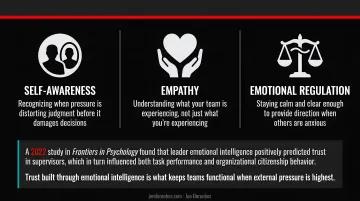
A 2022 study published in Frontiers in Psychology found that leader emotional intelligence positively predicted trust in supervisors, which in turn influenced both task performance and organizational citizenship behavior. Trust built through emotional intelligence is what keeps teams functional when external pressure is highest.
The Mindset Reframe
One practical shift leaders can apply immediately: stop asking "How do I stop this disruption?" and start asking "What does this disruption make possible?"
That question doesn't minimize difficulty. It redirects cognitive resources from reactive damage control toward proactive opportunity creation — which is exactly the mode effective leaders need to operate in.
Practical Strategies for Leading Through Disruption
Strategy 1: Cultivate Adaptive Thinking
Adaptive leaders stay in a continuous learning posture. They experiment, adjust when evidence demands it, and model intellectual humility for their teams.
Three concrete behaviors:
- Seek diverse perspectives before major decisions — not as a courtesy, but as a quality-control mechanism
- Pilot ideas at small scale before committing to full rollout, so course corrections cost less
- Normalize course corrections explicitly — frame them as strategic intelligence, not as failure
This matters more than most leaders realize. McKinsey reports that only 16% of global employers invest in adaptability and continuous-learning programs — meaning the organizations that do build this capacity hold a compounding advantage.
Strategy 2: Communicate with Radical Transparency
When information is absent, people fill the gap with anxiety, rumor, and disengagement. Effective leaders over-communicate: sharing what they know, what they don't know, and what they're actively doing about both.
Anchor all communications to the organization's long-term vision and values. Even difficult news, delivered against a clear "why," is easier to process than vague reassurances.
Strategy 3: Build Psychological Safety
Teams under disruption need to feel safe voicing concerns, proposing unconventional ideas, and making mistakes without fear of punishment. Google's Project Aristotle identified psychological safety as the first of five key team dynamics — ahead of dependability, structure, meaning, and impact.
Practical behaviors:
- Explicitly invite dissent in team conversations ("What are we missing here?")
- Respond to failure with curiosity rather than blame
- Acknowledge the emotional weight of change rather than pretending it's business as usual
Gartner research found that managers who created psychological safety could reduce reported change fatigue by as much as 46% — a significant number given that the average employee experienced 10 planned enterprise changes in 2022.
Strategy 4: Make Faster, Better Decisions Under Ambiguity
Waiting for certainty before acting is itself a decision, and rarely a good one. A practical framework:
- Define "good enough information" — what's the minimum you need to act responsibly?
- Set a decision deadline — pick a date and commit to it
- Act with available data while remaining explicitly open to course correction
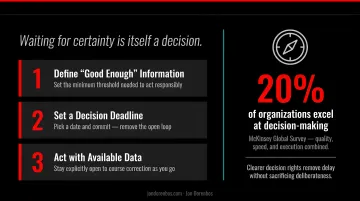
McKinsey's global survey found that only 20% of organizations excel at decision-making, with high performers combining quality, speed, and execution rather than prioritizing speed alone. Clearer decision rights and structured frameworks remove unnecessary delay without sacrificing deliberateness.
Strategy 5: Lead with Purpose, Not Just Process
Better decisions keep teams moving — but sustained performance under uncertainty requires something deeper than process. During disruption, employees don't just need direction. They need meaning. McKinsey's 2021 survey of 1,021 US workers found that employees who reported living their purpose at work were four times more likely to report higher engagement. Nearly two-thirds reconsidered their sense of purpose because of COVID-19.
Leaders who can connect daily work to a larger "why" retain engagement, reduce turnover, and sustain performance through extended uncertainty. Purpose isn't a motivational poster. It's what holds teams together when process and certainty both fail.
Building a Team That Adapts and Thrives
Individual leadership resilience matters — but it isn't enough on its own.
Organizations need collective adaptability — where teams share a growth mindset, communicate across boundaries, and own shared challenges together rather than retreating to silos.
Three Cultural Conditions Leaders Must Build
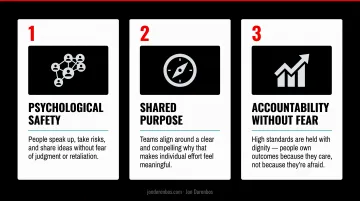
| Condition | What It Looks Like in Practice |
|---|---|
| Continuous learning environment | Development is ongoing, not event-based — learning is woven into workflows, not confined to annual training |
| Shared direction and alignment | Team members understand how their individual work connects to broader outcomes, not just their job description |
| Psychological safety under pressure | Honest, high-stakes conversations happen before crises — not only during them |
The Hidden Cost of Neglecting Team Wellbeing
Sustained disruption creates change fatigue. Gartner's data shows willingness to support organizational change dropped from 74% in 2016 to 43% in 2022 — a collapse that should concern any leader managing ongoing transformation.
Leaders who check in on morale, celebrate small wins, and create space for honest conversations about strain build something beyond resilience. They build retention. Teams that feel seen during hard periods are the ones still standing — and performing — when conditions improve.
Jon Dorenbos frames this principle through his own experience: "Life happens. Good, bad, and ugly. What separates people is how they handle it." For corporate leadership teams, the same logic applies at the organizational level — how a team handles sustained adversity determines whether it comes through weaker or stronger on the other side.
Frequently Asked Questions
What is disruptive leadership?
Disruptive leadership is a style that actively challenges the status quo, embraces bold change, and drives innovation within an organization. It's characterized by a willingness to question existing processes, welcome dissenting perspectives, and take calculated risks in pursuit of better outcomes — rather than protecting the way things have always been done.
How do you lead through disruption?
Leading through disruption means cultivating an adaptive mindset, communicating transparently, building psychological safety, and making confident decisions with incomplete information. Anchoring your team in shared purpose — even when the path forward is unclear — is what sustains performance over time.
What are the key traits of a leader who thrives in disruption?
Resilience, emotional intelligence, adaptability, comfort with ambiguity, and the ability to inspire trust. These traits aren't fixed personality features — they're developed through deliberate practice, leadership development, and the lived experience of navigating real adversity.
How does resilience help leaders navigate change?
Resilient leaders recover faster from setbacks, maintain clearer thinking under pressure, and serve as emotional anchors for their teams. This is why resilience mindset work is increasingly treated as a strategic leadership priority — not a personal development extra — particularly in organizations facing sustained disruption.
What is the difference between disruption and crisis in a business context?
A crisis is a sudden, high-stakes event requiring immediate response. Disruption refers to broader, ongoing shifts in markets, technology, or how work itself is organized. Today's leaders must be equipped to manage both simultaneously — using different frameworks for each.
How do you build a team culture that adapts to ongoing change?
Foster continuous learning, build psychological safety, align teams around shared purpose, and normalize iteration and course correction. Adaptive culture is built through consistent leadership behaviors practiced daily — not through one-time initiatives or offsite workshops.