
Schools and event planners often struggle to tell the two apart before the invitation goes out. Fame doesn't guarantee a memorable speech. NPR's review of more than 300 commencement speeches found the strongest ones share specific, learnable qualities: humor, humility, a clear message, and genuine empathy.
This guide breaks down exactly what to expect from a top-tier graduation keynote speaker, drawing on real examples of what separates the forgettable from the unforgettable.
Key Takeaways
- A great keynote pairs personal storytelling with one clear, usable lesson
- Top speakers customize their message instead of reciting generic advice
- Delivery, pacing, and authenticity matter as much as the words themselves
- Speakers like Jon Dorenbos pair live magic with a survival story so resilience lessons stick
What Makes a Graduation Keynote Speaker "Top-Tier"
A famous name on the program does not guarantee a strong commencement speech. Graduates respond to speakers who connect with their class, their school, and the moment they are in.
The best speakers earn their spot through authentic, relatable stories of resilience rather than a famous name or title alone. Inside Higher Ed's commencement guidance stresses the same point: know the institution, and engage the audience with a real story—more than a celebrity résumé.
Top-tier speakers typically:
- Research the graduating class's context before writing a single word
- Reference the school's mission, local traditions, or shared class experiences
- Bring a documented track record of hundreds of successful appearances
- Earn standing ovations and strong feedback consistently, regardless of venue
That customization separates elite speakers from circuit speakers who recycle the same talk at every stop. Jon Dorenbos, for example, built his keynote style around three unlikely pieces: 14 years of NFL long-snapping, a childhood marked by tragedy and foster care, and stage magic.
His team's process starts with a planning call on the school's goals, audience, and desired themes, then builds the address around that graduating class rather than a stock template.
The Track Record That Backs It Up
Consistency across 1,000+ events—for organizations including Apple, Marriott, and Kroger—shows the speaker can read a room, whether it holds 200 people or 3,400.

What Graduates and Attendees Can Expect During the Speech
Content and Structure
Forget a string of inspirational quotes. Audiences should expect one clear, memorable takeaway they can repeat weeks later.
The typical arc:
- A personal hook: a real story, not a résumé
- A moment of struggle or turning point: where things actually went wrong
- The lesson learned: stated plainly, without burying it in metaphor
- A call to action: something graduates can actually do

NPR's archive found "Embrace Failure" and "Change the World" among the most durable commencement themes. Both work because they're attached to one honest story, not a list of platitudes.
Tone and Delivery
The strongest speakers vary their pace and energy deliberately. A room full of restless graduates and exhausted parents needs peaks and valleys, not a monotone lecture.
Hallmarks of strong delivery:
- Self-deprecating humor that brings the room in
- Emotion that feels earned rather than staged
- A conversational voice instead of a recited script
Length and Format
Academic research points to 5-10 minutes as a strong benchmark—roughly 650-1,500 words at a natural speaking pace. Student and convocation speakers often get tighter 3-5 minute slots; an invited keynote usually gets more room. The University of Michigan's 2026 keynote ran about 10 minutes.
Brevity matters because attention is finite. A well-paced 8-minute speech beats a rambling 20-minute one every time.
How Top Speakers Personalize the Message for Graduates
Generic speculation about "the world graduates are entering" ages badly—and fast. Leading speakers avoid it entirely, focusing instead on lessons that hold up regardless of the economy, technology, or news cycle.
Personalization typically happens through:
- Pre-event calls between the speaker's team and organizers, covering goals, audience, and shared class experiences
- References to the specific institution's mission or values
- Interactive elements that make abstract lessons tangible
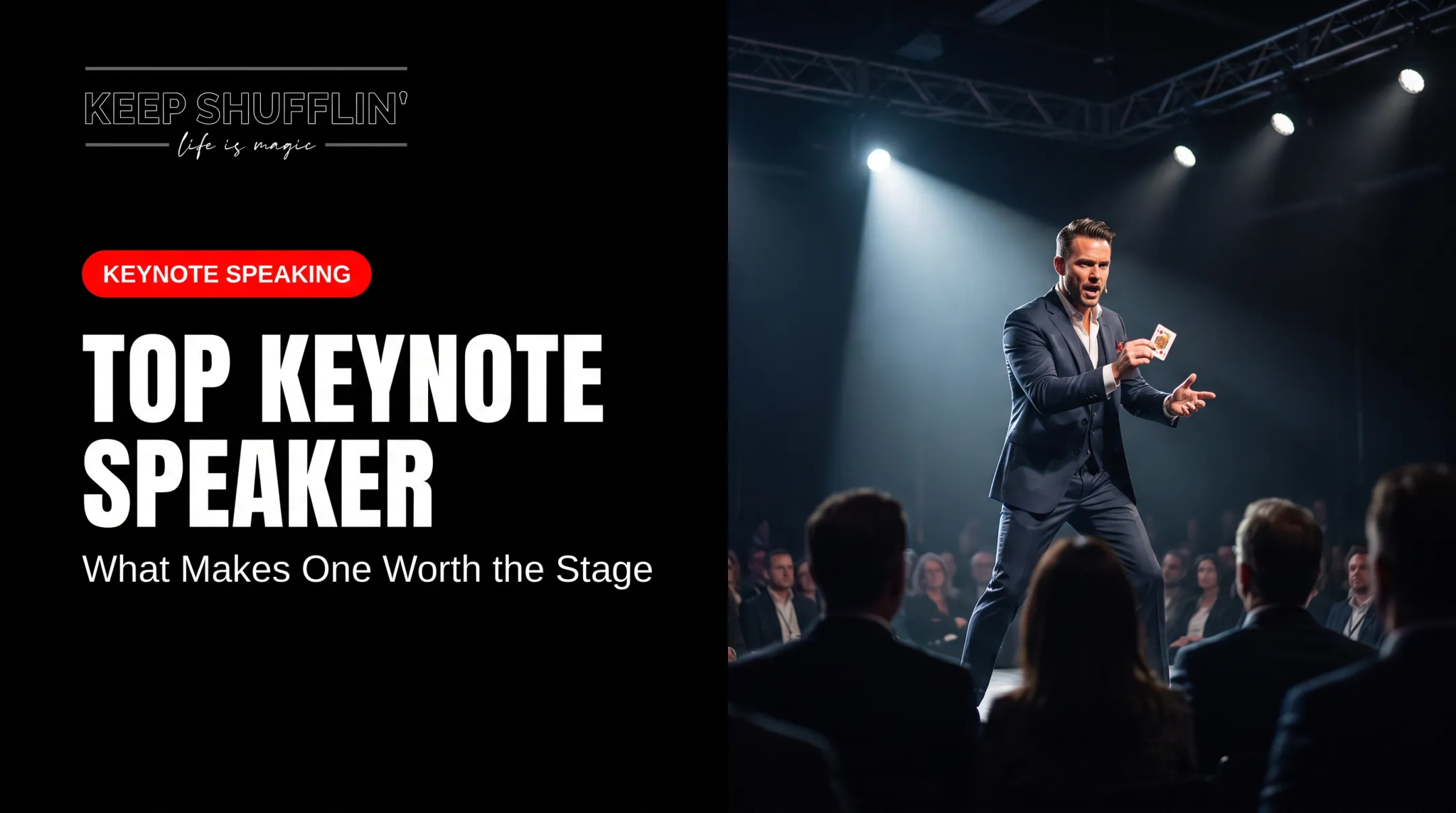
Jon Dorenbos's approach shows this last point well. At the ACEC General Session, he used a deck of cards as a running metaphor for life, tying sleight-of-hand tricks directly to the story of rebuilding after his father murdered his mother when he was 12.
The message: "Life happens. Good, bad, and ugly. What separates people is how they handle it." The magic isn't a sideshow. It physically demonstrates that you can't control every card you're dealt—only how you play it.
That interactive beat works because the intake came first. Understanding an audience's goals before writing a word is standard for speakers who take customization seriously, on a corporate stage or a commencement one.
The Business/Entertainment Side: What Event Planners Should Expect
Booking a top-tier keynote speaker typically follows a predictable sequence:
- Initial inquiry: event details, audience size, objectives, budget range
- Consultation call: the speaker's team discusses goals and tailors the message
- Confirmation and prep: technical rider, travel, and stage setup reviewed
- Event day: arrival a day early is common, with roughly 45 minutes for setup and rehearsal

What professionalism looks like in practice:
- Stage readiness: 1,000+ prior appearances mean a polished performance at any venue size
- Fast communication: Jon Dorenbos's team responds to inquiries within 24 hours
- Clear logistics: a documented rider covering staging, props, and tech needs
Consistency across different audiences, from Fortune 500 sales conferences to nonprofit galas, is one of the clearest signals a speaker will perform at the level a graduation ceremony demands.
Common Mistakes That Weaken a Graduation Keynote
Even experienced speakers fall into predictable traps:
- Self-congratulation — spending more time on the speaker's résumé than the graduates' journey
- Over-reliance on quotes or dictionary definitions — a crutch that signals a lack of original thought
- Speaking too long — losing the room after minute ten
- Failing to connect with the class — generic advice that could fit any graduation, anywhere
A strong graduation keynote avoids all four. Name the institution correctly, reference what the class actually shared, and end within the time organizers set.
Frequently Asked Questions
What is a keynote speaker at graduation?
A graduation keynote speaker is the featured guest who delivers the commencement address, offering inspiration, reflection, and forward-looking advice to the graduating class. The role is ceremonial, centered on the audience's milestone, not the speaker's resume.
How long does a keynote speaker speak?
Most academic guidance recommends 5-10 minutes for an invited keynote, though student speakers often face tighter 3-5 minute limits. Concise, well-paced speeches tend to be far more memorable than long ones.
What qualities should schools look for when choosing a graduation speaker?
Prioritize relatability, authentic storytelling, and alignment with the class's values over pure celebrity status. A track record of consistent audience response across many events is a strong signal.
How do speakers customize their message for different graduating classes?
Speakers typically research the school and talk with organizers first. They learn the mission, the class's shared experiences, and desired themes, then build the address around that context.
Can entertainment (like magic) work in a graduation keynote speech?
Yes, when it's tied meaningfully to the message. Jon Dorenbos, for instance, uses card magic as a metaphor for resilience, turning an abstract idea into something the audience can watch unfold live.
What makes a graduation speech memorable years later?
One clear, applicable piece of wisdom combined with authentic emotion tends to stick with audiences far longer than a string of generic platitudes or borrowed quotes.