Many planners underbudget because they don't realize speaker pricing works in tiers, or they forget that travel, A/V, and add-ons often sit outside the quoted fee. That gap between the "sticker price" and the real invoice catches teams off guard every year.
This guide breaks down what drives speaker fees up or down, what's typically bundled into a quote, and how to budget for a speaker who actually fits your event.
Key Takeaways
- Fees span $500 for emerging speakers to $100,000+ for celebrity or bureau-represented names
- Experience, fame, event format, and travel needs are the biggest cost drivers
- Virtual bookings typically cost 20-50% less than in-person engagements
- Entry-level and mid-tier speakers fit smaller internal events; premium fees suit flagship conferences
- Premium fees pay off when name recognition or story drives attendance or press coverage
How Much Does a Guest Speaker Cost? (Pricing Overview)
There's no fixed price tag for a guest speaker. Cost moves based on who they are, what kind of event you're hosting, and what extras get negotiated into the deal.
A few budgeting mistakes trip up planners repeatedly:
- Assuming every "professional speaker" charges roughly the same
- Forgetting that travel and A/V are usually billed separately
- Booking a recognizable name without confirming what's actually included in the fee
Here's how the market generally breaks down.
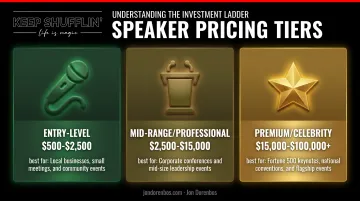
Entry-Level / Emerging Speakers: $500 – $2,500
These speakers typically deliver a single 30-60 minute session with standard, often local, travel and minimal customization.
Best for: internal team meetings, small conferences, workshops, or organizations testing a topic before committing to a bigger booking.
Mid-Range / Professional Speakers: $2,500 – $15,000
This tier covers established speakers with a proven track record: a polished, rehearsed keynote with moderate customization to your audience.
Best for: mid-sized conferences, association events, or company-wide meetings that need a reliable, experienced presenter without celebrity-level spend.
Industry data helps frame this band. A 2024 PCMA survey of event organizers and speakers found speakers reported an average fee closer to $14,000, while organizers budgeted roughly $22,449 on average. Treat both as planning benchmarks, not universal quotes.
Premium / Celebrity & Bureau-Represented Speakers: $15,000 – $100,000+
This tier includes speakers with real name recognition — former athletes, TV personalities, bestselling authors — who bring both content and audience draw.
Speakers who pair a compelling personal story with a distinct skill or performance element often land here. They deliver credibility and entertainment in the same package.
Jon Dorenbos is one example: a 14-year NFL veteran, "America's Got Talent" finalist, and magician who has delivered over 1,000 keynotes for companies including RE/MAX, Marriott, Kroger, and Campbell Soup Company. His engagements begin at an $80,000 minimum booking investment, which places him in the celebrity tier rather than the general professional-speaker market.
Best for: flagship conferences, sales kickoffs, leadership summits, or brand events where the speaker doubles as part of the marketing draw.
Key Factors That Affect the Cost of a Guest Speaker
Pricing depends on the speaker's profile as much as the specifics of your event.
Experience, Fame, and Track Record
Speakers with media recognition, published books, or a distinctive personal story (a pro-sports career, a reality-TV run) can command higher fees because they bring an audience along with the content. Credentials alone don't guarantee a higher price. Market demand and reputation matter more than a resume line.
Event Format: Virtual vs. In-Person
Virtual engagements typically cost 20-50% less than in-person bookings, since travel time, prep logistics, and accommodation are no longer factored in, according to eSpeakers' 2026 budgeting guide. A speaker who charges $15,000 in-person might land closer to $8,000-$12,000 for a virtual session.
Event Type and Audience Size
Larger, higher-stakes events such as annual conferences and sales kickoffs tend to command higher fees than a quiet internal training session. Audience size alone doesn't always change the quote; plenty of speakers price based on event type and purpose rather than headcount.
Level of Customization
A generic, off-the-shelf talk costs less than a fully customized keynote built around your company's mission or industry challenges. Expect customization to raise the price. The more research and tailoring involved, the more prep time it demands.
Travel, Logistics, and Booking Timeline
Travel distance, last-minute requests, and peak-season demand all add pressure to the base fee. Booking early gives you more room to negotiate; asking someone to clear their calendar in three weeks does not.
Cost Breakdown: What's Included Beyond the Speaking Fee
The quoted "speaker fee" is rarely the full cost of hiring a guest speaker. Here's what else typically shows up on the invoice:
- Speaker fee (one-time): the core payment for the speech or session itself
- Travel and accommodation: airfare, ground transport, and hotel, usually billed separately (local speakers excepted). Domestic travel commonly runs $800–$2,500, per eSpeakers
- Technical and A/V requirements: equipment or production needs beyond what the venue already supplies
- Materials, books, or add-ons: attendee book copies, meet-and-greets, or workshop add-ons that aren't always bundled into the base fee
For premium bookings, these add-ons can be substantial. Jon Dorenbos's team, for instance, offers bulk copies of his book Life Is Magic at a discounted per-copy rate, plus VIP pre-event receptions with photo opportunities and card-trick performances—all negotiated separately from the core keynote fee.
If you're weighing a similar booking, reach out directly to confirm exactly what's included before you finalize a budget.
Low-Cost vs. High-Cost Guest Speakers — What's the Difference?
Both ends of the pricing spectrum can deliver value. The difference comes down to what you're actually buying.
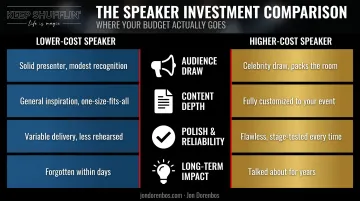
- Audience draw: Lower-cost speakers rely on topic relevance alone; higher-cost speakers add name recognition that can boost registration and attendance.
- Content depth: Lower-cost speakers often deliver solid, general content; higher-cost speakers tailor the message to your industry and goals.
- Polish and reliability: Lower-cost speakers can vary in prep and consistency; higher-cost speakers typically bring a rehearsed presentation with fewer last-minute surprises.
- Long-term impact: Lower-cost talks may end when the session does; higher-cost speakers often leave a memorable, quotable takeaway that extends the event's value.
A $1,000 speaker and a $50,000 speaker aren't competing for the same job. One fills a session slot competently. The other becomes part of why people remember your event at all.
How to Estimate the Right Budget for Your Guest Speaker
The "right" cost depends on fit with your goals, not just the lowest available price.
Before setting a number, consider:
- Purpose and audience size: A 50-person internal training doesn't need the same investment as a 2,000-person national conference
- Desired customization: Custom content built around your brand costs more than a general talk
- Format: Virtual vs. in-person changes your budget by 20-50%
- Marketing value needed: Decide whether the speaker also needs to help sell tickets or generate buzz
One practical tip: book further in advance and stay flexible on dates. That approach helps secure better rates and availability, even for premium or celebrity-tier speakers whose calendars fill up fast.
Frequently Asked Questions
How much does a guest speaker cost?
Fees generally range from $500 for emerging speakers to $100,000+ for celebrity or bureau-represented names. Most professional, mid-tier speakers fall between $2,500 and $15,000.
What is a typical honorarium for a guest speaker?
An honorarium is a token thank-you rather than a full professional fee, and amounts vary widely by institution. There's no universal standard — some organizations cap honoraria at a few hundred dollars, others go up to a few thousand for a distinguished guest.
Are virtual guest speakers cheaper than in-person speakers?
Yes. Virtual events typically cost 20-50% less than in-person bookings since travel and preparation time are reduced.
What additional costs should I budget for besides the speaker fee?
Plan for travel, accommodation, A/V needs, and any optional materials or add-on sessions. These are rarely included in the base fee for in-person events.
How far in advance should I book a guest speaker to get the best rate?
Booking six or more months ahead generally gives you better selection and more room to negotiate, especially for in-demand or premium speakers. Booking inside 60 days often removes that flexibility entirely.
Is it worth paying more for a celebrity or well-known guest speaker?
It can be, especially for flagship events. Premium speakers earn their fee when their name recognition and story help drive attendance, generate media buzz, or leave a lasting impression on the audience.