
Introduction
An event planner stands up and announces the lineup: a keynote speaker for the opening session and a guest speaker for the afternoon breakout. Half the room nods along. The other half quietly wonders if there's a real difference, or if it's just a fancier title on the same invoice.
That confusion matters more than it seems. Mixing up these roles can throw off your budget, your agenda, and what your audience walks away expecting — especially at corporate conferences and sales kickoffs where every session competes for attention.
This guide breaks down what separates a keynote speaker from a guest speaker: their roles, typical fees, best-fit use cases, and how to decide which one your event actually needs. We'll close with a real-world example: watching a celebrity keynote turn a distracted ballroom into a standing ovation.
Key Takeaways
- A keynote speaker headlines the event, setting the overall tone
- Guest speakers add focused expertise in breakouts, panels, or workshops
- Keynote fees typically start higher; guest speakers often work for a smaller honorarium
- Your choice should hinge on event goals and budget, not speaker fame alone
- This kind of personal hook, like an NFL career paired with magic, often earns someone a keynote slot
Keynote Speaker vs. Guest Speaker: Quick Comparison
Here's the side-by-side breakdown planners reference most often.
| Factor | Keynote Speaker | Guest Speaker |
|---|---|---|
| Role & Purpose | Sets the overall tone and delivers the event's central message | Reinforces the theme with a deeper dive into a specific subtopic |
| Speaking Fee | Often the highest-paid speaker on the roster | Usually lower, an honorarium, or exposure/travel only |
| Event Placement | Opens or closes the event; typically 30-60 minutes | Slotted into breakouts, panels, or workshops |
| Audience Expectation | Inspire, motivate, energize the whole room | Educate and deliver practical, niche takeaways |
On fees specifically, the numbers back this up. A 2024 survey of 340 event organizers and 378 speakers found an average keynote budget of $22,449, with 47% of planners reporting a range between $10,000 and $50,000.
There's no equivalent industry-wide benchmark for "guest speaker" fees. That role gets priced by the person and the format, not a standard label.
What Is a Keynote Speaker?
A keynote speaker is the headliner. They're the person responsible for setting the tone of the entire event through storytelling, motivation, or thought leadership. That's exactly why event planners treat this booking as one of their most critical decisions.
The core benefit is emotional alignment. A strong keynote gets the audience feeling connected to the organization's mission before the deeper, more tactical content arrives later in the day. That emotional runway is hard to replicate with a mid-day breakout session.
Opening, Closing, and Thematic Variations
Keynotes aren't one-size-fits-all. They typically fall into a few functional categories:
- Opening keynote: sets the stage and frames the event's central message right from the start
- Closing keynote: sends attendees off with a final push toward action
- Thematic or motivational keynote: built around a specific organizational need, such as resilience, change, or accountability
Selecting the right format early keeps the rest of the agenda from feeling disconnected, since each type builds toward a distinct moment in the program. A professional keynote generally runs 30 to 60 minutes, depending on whether it's opening or closing the program.

What Planners Actually Look For
Most planners aren't just hunting for a big name. They're looking for:
- A compelling personal story that connects to the audience's own challenges
- Genuine stage presence, holding a room without needing a moderator
- A unique differentiator that makes the presentation memorable, not generic
- Relevant expertise that speaks directly to the industry or challenge at hand
Jon Dorenbos is a good example of this blend. Fourteen years as an NFL long snapper, followed by a run as an America's Got Talent finalist, gives him a credibility-plus-entertainment combination that's hard to replicate. That mix is precisely what turns a "motivational talk" into a room full of standing ovations.
Where Keynotes Fit Best
Keynotes dominate at events where the entire audience needs to hear the same unifying message at once:
- Large conferences and multi-day association events
- Company all-hands meetings, leadership retreats, and sales kickoffs where the whole team needs to align around a new push
Fortune 500 organizations, including Apple, Marriott, and Kroger, routinely invest in keynote speakers for exactly this reason. When an entire sales force or leadership team needs to leave a room feeling the same sense of momentum, a single, high-impact voice does that better than a panel discussion ever could.
What Is a Guest Speaker?
A guest speaker is an outside expert brought in to add value on a specific topic, without carrying the responsibility of setting the entire event's tone. It's a different job with a different scope, and it matters just as much for well-rounded programming.
The core benefit here is cost-effective depth. Guest speakers let organizers deliver specialized insight, the kind a general keynote can't cover in 45 minutes, without the investment or spotlight that comes with a full keynote booking.
Common Guest Speaker Formats
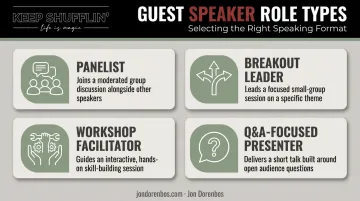
The "guest speaker" label usually covers a handful of specific roles:
- Panelists: one of several experts discussing a topic, typically moderated
- Breakout leaders: running a smaller, specialized session away from the main stage
- Workshop facilitators: guiding hands-on exercises rather than delivering a straight speech
- Q&A-focused presenters: shorter, interactive sessions built around audience questions
Panels don't automatically succeed just because there are multiple experts in the room. One industry study found 63% of attendees rated panels as "merely okay or worse", a reminder that format and moderation matter more than star power in this role.
Where Guest Speakers Fit Best
Guest speakers shine in settings that need subtopic depth rather than a single unifying moment:
- Multi-day conferences with concurrent tracks
- Technology summits and healthcare conferences needing subject-matter specificity
- Internal corporate training sessions focused on a narrow skill or process
A well-built agenda often pairs both roles: the keynote frames the shared message, then guest speakers extend it through specialized sessions. Attendee research supports this pairing. According to Freeman's 2024 attendee survey, 70% of attendees say they attend events specifically for learning content, and 56% value hands-on interactions.
That same survey found only 1% of attendees ranked celebrity stories as their preferred keynote topic, compared to 39% for innovation and 34% for industry expertise. Relevance beats fame at the guest-speaker level, and often at the keynote level too.
Keynote Speaker vs. Guest Speaker: Which One Does Your Event Need?
The decision comes down to four factors:
- Event goal: are you trying to inspire the whole room, or educate a specific segment?
- Budget: keynote-level fees start in the five figures; guest speaker costs vary widely
- Audience size: a packed general session calls for a different speaker than a 30-person breakout
- Program structure: single-session events lean keynote; multi-track conferences need both
Choose a keynote speaker if you need one memorable, unifying moment that energizes the entire audience and reflects your brand.
Choose a guest speaker if you need focused expertise on a specific challenge that doesn't require the whole room's attention.
A Real-World Scenario
Picture a national sales organization heading into its annual conference. The team is coming off a tough quarter, morale is uneven, and leadership needs more than another slide deck about targets. They need the room to feel something before they hear the numbers.
This is the exact situation where a standard guest presentation falls short. Organizations facing this challenge, RE/MAX among them, often skip the standard format entirely.
Instead, they book a celebrity keynote experience that blends personal storytelling with live entertainment. The result is one emotionally memorable moment the entire audience shares at once.
The proof shows up in the room itself. Nick Bailey, President and CEO of RE/MAX World Headquarters, described witnessing something he'd never seen before: an unsolicited standing ovation halfway through the presentation.
That's the kind of measurable outcome planners are actually chasing: not just applause at the end, but a room that can't wait until the finish to react.

Need that kind of unifying, high-impact keynote moment for your next event? Explore booking Jon Dorenbos for a presentation built around storytelling and live magic, customized to your organization's message.
Conclusion
Neither role outranks the other. A keynote speaker earns its higher fee and top billing by unifying an entire audience around one inspiring, brand-aligned moment. A guest speaker earns its place by going deep on a subtopic the keynote simply doesn't have time to cover.
The right call depends on what your event needs, not which speaker has the bigger name. Either choice pays off — stronger engagement, better brand alignment, and an event people are still talking about weeks later. For that one signature, brand-defining moment, Jon Dorenbos brings NFL experience, an America's Got Talent run, and a stage-stopping magic performance to corporate keynotes nationwide.
Frequently Asked Questions
What is the difference between keynote speaker and guest speaker?
A keynote speaker headlines the event and sets its overall tone, usually opening or closing the program. A guest speaker supports the agenda with focused insight on a specific topic, typically in a smaller session.
What is the role of a guest speaker?
A guest speaker adds specialized knowledge or a fresh perspective within panels, breakouts, or workshops. Their job is to complement the main event theme, not carry it.
What qualifies as a keynote speaker?
Keynote speakers are usually established experts or storytellers with strong stage presence and credibility. They need the ability to set the tone for an entire event, not just one session.
How much do keynote speakers typically charge compared to guest speakers?
Keynote speakers generally command higher fees due to their headline role, with celebrity-tier speakers often starting at $80,000 or more per engagement. Guest speakers typically charge less or accept an honorarium, depending on the event format and their profile.
Can the same person be both a guest speaker and a keynote speaker?
Yes. Many speakers move between both roles depending on the event — someone might keynote one conference and serve as a guest speaker or panelist at a larger one.
How do I decide whether to hire a keynote speaker or a guest speaker for my event?
Consider your event's primary goal, budget, and audience size. Choose a keynote for a unifying, high-impact moment, or a guest speaker for topic-specific depth.