
The evidence for closing that gap is clear. A 2021 peer-reviewed meta-analysis covering 33,078 participants found that narrative text outperformed expository text on both memory and comprehension — with an overall effect size of Hedges g = 0.72 for retention alone. Stories aren't just more engaging; they're neurologically stickier.
The leaders who consistently move people — from boardroom conversations to Fortune 500 stages — share one trait: they've built a deliberate library of stories mapped to specific outcomes. This isn't talent. It's a practice.
This post breaks down the 5 essential business story types every leader needs, what each one is built to do, how to craft and deliver each effectively, and the mistakes that quietly undercut even well-intentioned stories.
Key Takeaways
- Business storytelling is a strategic leadership tool — not a soft skill — that builds trust, drives action, and shapes culture.
- The 5 story types leaders need are: Trust, Teaching, Action, Values, and Vision — each serves a distinct purpose and moment.
- Fabricated or embellished stories erase the credibility storytelling is meant to build — authenticity isn't optional.
- The most common failure isn't a bad story — it's the right story told to the wrong audience at the wrong moment.
- Know the outcome each story type is designed to produce, then practice until delivery becomes second nature.
Why Every Leader Needs These 5 Business Stories
Leaders communicate constantly — in one-on-ones, town halls, investor presentations, sales pitches, and conference keynotes. Each of those moments calls for a different kind of story that produces a different emotional and behavioral outcome. Leaning on data alone, or defaulting to corporate-speak, means people leave the room without feeling anything — and without changing anything.
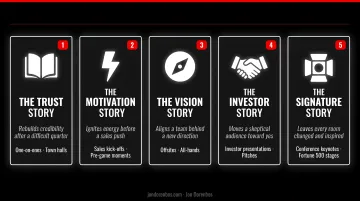
The most effective executive communicators don't wing it. They arrive with a deliberate story library mapped to specific moments — each narrative chosen to serve a specific need:
- Rebuilding trust after a difficult quarter
- Sparking motivation before a sales push
- Aligning a team behind a new direction
- Moving a skeptical investor toward yes
Speakers who perform on Fortune 500 stages — from Apple to Marriott to RE/MAX — don't show up with a generic script. Every story they tell has a job to do.
The 5-story framework is the foundation of that library.
The 5 Essential Business Stories and How to Master Each
The Trust Story
A Trust Story demonstrates your organization's values in action — not as a stated principle, but as a proven behavior. It answers the audience's unspoken question: Can I believe you?
The classic example: Apple's iPhone 4 antenna crisis in July 2010. When reports of signal loss spread, Steve Jobs held a press conference and said plainly, "We're not perfect. We know that. You know that. And phones aren't perfect either." Apple offered every iPhone 4 owner a free case and maintained a 30-day full refund policy. The contemporary reception was mixed — not a flawless PR recovery — but the willingness to name the problem directly, without deflection, is what makes it instructive. A trust story doesn't require a perfect outcome. It requires honesty under pressure.
How to build one:
- Be specific, not general — vague admissions of "challenges" build no trust
- Anchor it in the audience's current concerns, not your preferred talking points
- Follow a consistent structure for crisis contexts: name the truth, provide context, focus on corrective action
Delivery coaching: Resist the urge to clean up the messy parts. The moment where a decision was hard, or a mistake was made, is exactly where audiences lean in. Vulnerability paired with accountability is what creates trust — not polished spin.
The Teaching Story
A Teaching Story imparts a lesson through example rather than instruction. Done well, it makes the audience feel they arrived at the insight themselves.
Zappos built its customer service culture around exactly this kind of story. In June 2016, employee Steven Weinstein handled a customer call that lasted 10 hours and 43 minutes — no script, no timer, no pressure to end the conversation. That one story communicates more about Zappos's service philosophy than any policy manual could, because it's specific, human, and memorable.
How to craft one:
- Establish a relatable character in a recognizable situation
- Introduce a turning point where a different choice was made
- Let the lesson emerge from the narrative — don't state it as a tagline at the end
The best teaching stories from leaders come from their own professional lives and from what their teams do every day. Those moments are already in front of you; most leaders simply haven't recognized them as stories yet.
Delivery coaching: After sharing a teaching story, pause. Don't rush to explain the takeaway. The story's impact compounds when the audience has a moment to connect it to their own experience before you confirm what it means.
The Action Story
An Action Story focuses on what was done — specific decisions, concrete steps, and results achieved — in response to a real challenge. It demonstrates initiative and problem-solving in motion.
The Johnson & Johnson Tylenol crisis of 1982 remains one of the most documented action stories in business history. Seven people died after cyanide-laced capsules reached consumers in Chicago.
J&J issued public warnings, recalled Tylenol capsules nationwide (PBS and The New York Times both report more than 31 million bottles, though exact primary-source confirmation of that figure is limited), offered product replacements, and introduced tamper-evident packaging that later became an FDA-regulated industry standard. Harvard Business School published the case within weeks and lists it as a bestseller still used in classrooms today.
Four structural hallmarks of a strong action story:
- Event-driven — rooted in what actually happened, not what was planned
- Outcome-focused — the result is clearly stated and meaningful
- Motivational — it inspires similar behavior in others
- Instructional — audiences can extract a transferable lesson
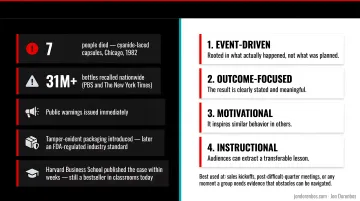
Action stories are the right choice for sales kickoffs, post-difficult-quarter team meetings, or any moment when a group needs evidence that obstacles can be navigated.
Delivery coaching: Include enough concrete detail to make the story vivid and credible. But stay focused. The instinct to over-explain every step dilutes momentum. End on the result and what it meant — not a list of lessons learned.
The Values Story
A Values Story turns an organization's core principles into evidence through specific behavior — not a mission statement read from a slide, but a real moment when someone acted in alignment with what the company says it stands for.
TOMS built an entire brand identity around its original One-for-One model: buy a pair of shoes, and TOMS donates a pair to a child in need. That giving model, launched in 2006, became a values story so central to the brand that it shaped consumer behavior and investor perception for over a decade. (TOMS expanded the model through impact grants in 2019 and fully moved away from One-for-One in 2021 — itself an instructive example of how values stories must evolve with the organization.)
Values stories don't require grand gestures. An employee who stayed two hours late to solve a customer's problem, or a leader who chose a more expensive vendor because of ethical sourcing practices, are equally compelling.
How to operationalize values storytelling:
- Build a rhythm for collecting and sharing these moments — monthly recognition, town hall spotlights, onboarding examples
- The difference between values on a wall and values in a story is the difference between a declaration and proof
- Employees trust the story. They tune out the poster.
In practice: Tell the story simply. Don't name the value mid-narrative — let the audience identify it, then confirm. That technique creates stronger emotional buy-in than announcing, "This is a story about integrity."
The Vision Story
A Vision Story articulates where the organization is going and why it matters — in a way that excites rather than informs. It's the narrative leaders tell to align people behind a future that doesn't exist yet.
Jeff Bezos did this with unusual consistency from Amazon's earliest days. His 1999 shareholder letter articulated a clear aspiration: "Our vision is to use this platform to build Earth's most customer-centric company, a place where customers can come to find and discover anything and everything they might want to buy online."
He repeated that long-term orientation across multiple years of communication until the company's reality caught up with the story. (Note: the phrase "everything store" became a popular framing through journalist Brad Stone's 2013 book — it is not a direct Bezos quote from his letters.)
Components of a compelling vision story:
- A brief, honest portrait of the current state (don't skip the friction)
- A vivid and specific picture of the desired future
- An emotional bridge that puts the audience inside that future — as participants, not observers
Vision stories fail when they're too abstract ("we'll be the best"), too corporate ("we'll optimize shareholder value"), or delivered only once. A vision story earns its power through repetition across multiple contexts and channels.
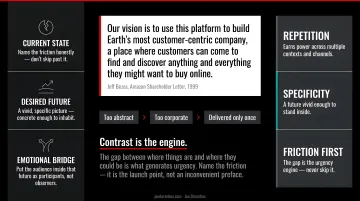
Delivery coaching: Contrast is the engine of a vision story. The gap between where things are and where they could be is what generates urgency. Name what's currently frustrating or limiting — don't skip past it. That friction is the launch point, not an inconvenient preface.
What You Need Before You Start Crafting Your Business Stories
Know Your Audience First
Before crafting any story, clarify what outcome you want the audience to leave with. Trust? Motivation? Clarity? Inspiration? That outcome determines which of the 5 story types you reach for and how you shape the narrative.
The same story told to a sales team, a board of directors, and a company all-hands will have different emphases, different details, and a different emotional tone. A single story event can serve multiple purposes — but you have to decide the primary one before you start building.
Build a Story Inventory
The constraint most leaders feel isn't a shortage of stories. It's a failure to recognize and archive the stories they already have.
Start a running collection of real moments from your professional life — organized by story type:
- Wins and failures that reveal character under pressure
- Team behaviors that model what good looks like
- Customer interactions that illuminate your values
- Pivots that demonstrate resilience
Keep the inventory active. The best story for a given moment is often one you encountered two weeks ago, not two years ago.
Run an Authenticity Check
Once you have a story inventory, one temptation surfaces quickly: the urge to embellish — or invent — when real stories feel "not interesting enough." Fabricated stories erode exactly the credibility storytelling is meant to create. The answer is to dig deeper into the real one, not hunt for a better one.
A true story becomes riveting when you stop summarizing it and start inhabiting it. That means surfacing:
- The specific sensory details of the moment
- The emotional texture — what you felt, not just what happened
- The point of genuine uncertainty, before you knew how it would end
- The decision or shift that changed the outcome
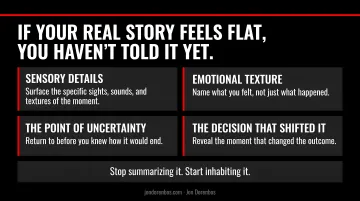
If your real story feels flat, you haven't told it yet.
Key Variables That Determine Whether a Business Story Lands
The quality of the story itself is only one factor. Delivery, timing, specificity, and audience fit all determine whether a story moves a room or disappears the moment you stop talking.
Specificity
Research on concrete versus abstract language consistently shows that concrete words are far easier to recall than abstract ones. In storytelling terms: vague stories are forgettable. Stories with named characters, real stakes, and specific details are memorable.
Compare these two versions:
- "We had a challenging quarter" — gone the moment you say it
- "In Q3, we lost our three largest accounts in 40 days" — stays with the room
Specificity signals authenticity. It makes the story feel real rather than constructed.
Audience Alignment and Where You End
Stories should end on the audience — not the storyteller. The emotional state the audience is in at the conclusion of a story directly influences their next behavior. If you pull focus back to yourself at the resolution — wrapping up with what you learned, how you felt, what you did next — you break the visualization the audience has been building throughout the story.
End in their world. Leave them inside the experience, not watching you reflect on it.
Common Mistakes Leaders Make When Telling Business Stories
Three patterns consistently undercut even well-intentioned business stories:
Telling It Like a Report
Listing events in chronological order without emotional stakes or sensory detail produces something closer to hospital rounds than storytelling. Neuroscience research confirms that the amygdala modulates the consolidation of emotionally arousing memories — meaning the brain holds onto vivid content and discards the rest. A story told without emotional texture is forgotten as soon as the next slide appears.
Mismatching Story Type to Moment
Using a vision story when the audience needs trust rebuilt, or opening with a teaching story when the room is burned out, signals a fundamental misread of the room. Leaders who study their audience before presenting and choose the right story type for the context consistently outperform those who default to their favorite story regardless of what the moment demands.
Relying on Corporate Language
Overused phrases and business jargon trigger the brain's pattern-recognition system — and the brain tunes out. Replace corporate-speak with concrete, human language that a non-expert could picture and feel. "We aligned our go-to-market strategy" tells no one anything. "We called every account we'd lost in the past year and asked them what went wrong" is a story beginning.
Conclusion
Mastering the 5 essential business stories — Trust, Teaching, Action, Values, and Vision — isn't about becoming a natural-born storyteller. It's about building a deliberate practice: finding real moments, structuring them with intention, and delivering them in a way that serves a specific audience and a specific outcome.
The leaders who consistently command rooms, build aligned teams, and inspire action aren't more charismatic by nature. They've invested in knowing which story to tell, when to tell it, and how to end it in a way that moves people forward.
For those who want to see this mastery modeled live, Jon Dorenbos has delivered that kind of keynote more than 1,000 times — weaving all 5 story types into a single continuous arc for Fortune 500 audiences across the country. CEOs have called it the best keynote they'd ever seen, with standing ovations mid-presentation.
The framework is learnable. Watching it performed at that level shows you exactly what to aim for.
Frequently Asked Questions
What are the main principles of storytelling for companies?
Authenticity, audience clarity, a clear purpose, emotional engagement, and simplicity. The best corporate stories are true, specific, and told in service of the audience's understanding — not the storyteller's image.
How do companies use storytelling?
Across internal communications (culture-building, vision alignment, change management), external marketing (brand narratives, customer case studies), leadership messaging (town halls, keynotes, onboarding), and sales (trust-building with prospects). Each channel draws on different story types, but the underlying mechanics are the same.
What makes a business story memorable?
Specificity — named people, real stakes, concrete details — combined with emotional resonance and ending on the audience rather than the storyteller. The specific details you choose signal to listeners whether the story is worth remembering.
What is the difference between a trust story and a values story?
A trust story demonstrates that the organization acts with integrity when under pressure or after a mistake. A values story shows what the organization stands for through everyday behavior. Both build credibility — but in different contexts and with different emotional registers.
How long should a business story be?
There's no fixed length, but brevity sharpens impact. A tight 90-second story told with emotional precision will outperform a sprawling five-minute narrative. Cut any detail the audience doesn't need to reach your intended takeaway.
How do I start with business storytelling if I don't consider myself a natural?
Start with inventory: write down 10 real professional moments involving a challenge, a decision, a lesson, or an outcome. Map each to one of the 5 story types. Then practice telling one out loud before a low-stakes meeting and iterate from there.